









The hours are brutal and the stakes are high. So what keeps elite lawyers balanced and able to carry on? Jeffrey Huang reports
It is two in the morning. The last email has just been reviewed and sent. Intense courtroom arguments still echo in the mind, but in a few hours, an anxious client will be waiting for the latest update on the case.
For many elite lawyers, this is not a last-minute scramble to meet a deadline, but an everyday reality. Demanding clients, complex contracts, rapid shifts in courtroom dynamics, and fierce market competition – pressure floods in from every direction of legal practice. The ability to manage that pressure and deliver work that satisfies clients, despite tight schedules and back-to-back deadlines, is a test of senior lawyers’ poise and judgement, as well as an essential skill for young lawyers breaking through and looking to move up.
The editorial team invited winners of China Business Law Journal’s A-List 2025-26 to participate in a survey. We asked how top lawyers balance mind and body, and cope with the stress when they leave work, helping them to continue to inspire the industry and the next generation while providing high-quality representation to clients.
Exercise: strengthen the body
For many elite lawyers, sport is the most direct and effective way to relieve stress. Whether sweating on the pitch, cutting through water in the pool, or darting back and forth at a ping-pong table, these activities help lawyers distance themselves from dry legal provisions and tedious preparatory reading, instead honing the physique and relaxing the mind.
Hu Gang, a Beijing and Hong Kong-based director and deputy general manager of China Patent Agent (HK), views sport as his “exclusive key” to dissolving stress. From football and baseball during his student days to years of badminton after entering the workforce, and now his current passion for tennis, he has found lasting joy in physical activity.
“The happiness brought by success at work stems from dopamine, while the pleasure of physical and mental expansion after exercise is more like the nourishment of endorphins,” he says. “These two types of ‘happy energy’ complement each other, allowing a professional career to proceed more steadily and further.”
Different respondents have their own insights on the pleasures of sport. Lei Dian, a partner at BZW Law Firm’s Beijing office, loves swimming. When she focuses on the sensation of her body moving through the water, the case files and legal provisions that crowd her mind flow away, and she regains a calm and clear head. Yan Yongjun, a global headquarters partner at Yingke Law Firm’s Beijing office, frequently goes hiking. Through the grit required to climb step by step, he finds the tenacity needed to untangle a complex case thread by thread; enjoying the views after reaching the summit also releases pressure and builds fresh energy for solving problems.
Bai Lin, founder and managing partner of RongYing Law Firm’s Beijing office, is captivated by traditional martial arts, finding the constancy and patience required for a legal career within the refining of each kung fu move.
Among the many stories about sports, the relationship between Zhang Xingde, a senior partner at Hiways Law Firm’s Shanghai office, and golf carries the most philosophical weight. He regards it as a silent professional mentor that “repeatedly interprets for me the shared philosophy of challenges, rules and success”.
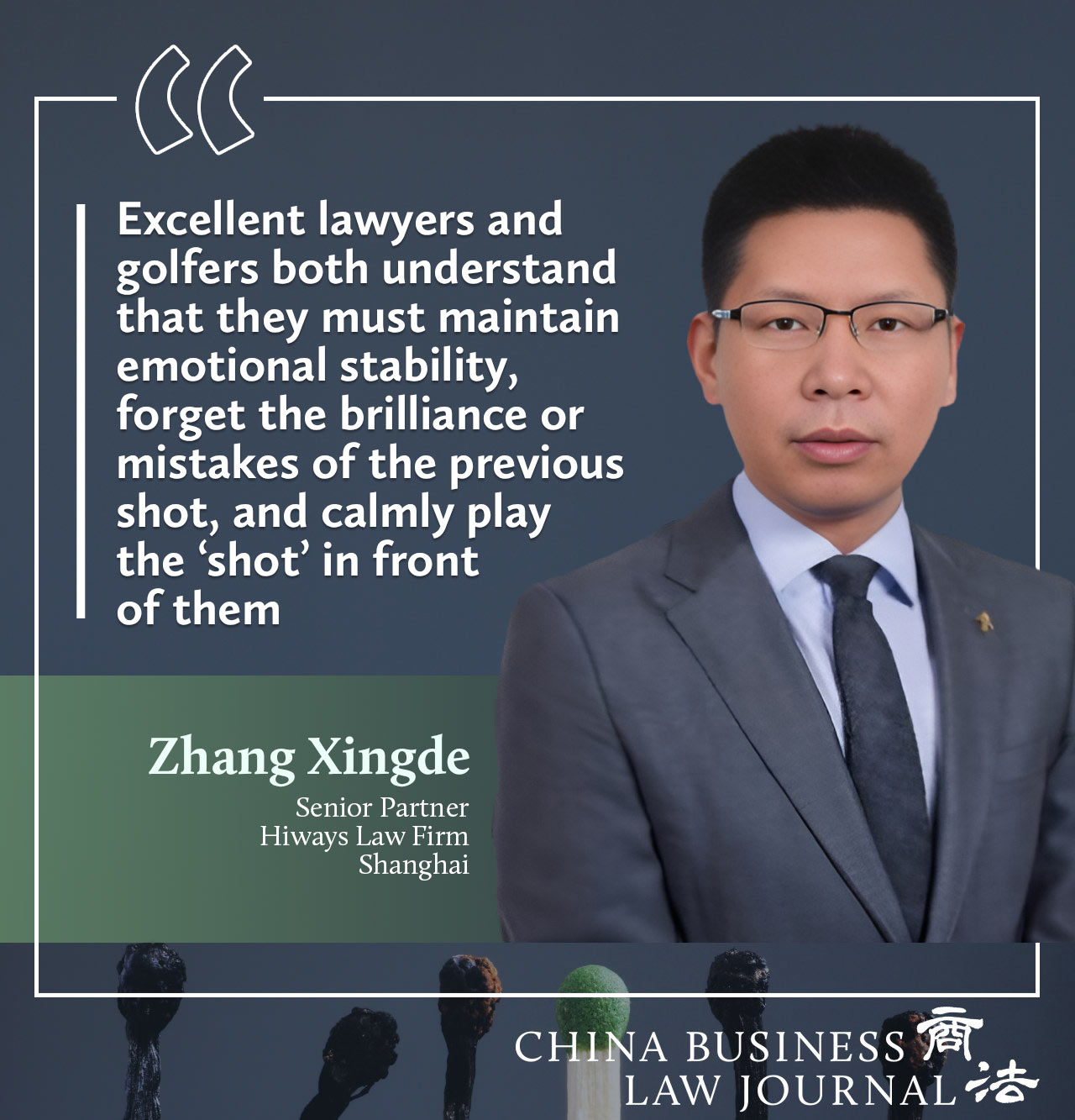
To Zhang, a golf match is like a complex case, requiring long-term strategy rather than temporary gains or losses. “A mis-hit off the tee into the long grass in one hole is like the sudden appearance of unfavourable evidence in a case; while a long-range putt in the next hole is like finding a breakthrough for a counterattack in court,” he says. “Excellent lawyers and golfers both understand that they must maintain emotional stability, forget the brilliance or mistakes of the previous shot, and calmly play the shot in front of them.”
Music: finding solace in melody
Music is a healing balm for the soul and a favourite for many interviewees. Classical music, with its rigorous structure and exquisite arrangements, is perhaps one of the preferred stress relievers for elite lawyers.
Bai Yaohua, a senior equity partner at DHH Law Firm’s Shanghai office, chooses the company of Bach’s fugues or Chopin’s nocturnes when he needs deep relaxation, or to organise his thoughts. “These compositions have rigorous yet emotional structures, helping my thoughts withdraw from the daily bustle,” he says.
Pan Jun, a Nanjing-based partner at Grandall Law Firm, also deeply appreciates Bach’s music. For lawyers accustomed to deconstructing facts with logic, “Bach’s music is like a perfect legal code built with notes – rigorous, symmetrical, yet filled with divine brilliance,” says Pan.
Sipping a cup of green tea as the timbre of a cello fills the room, “the anxiety that occupied my mind during the day is gently smoothed away by an invisible hand”, he says. “When the record reaches its finale and the tea is finished, I know I have cleared the battlefield within.”

Styles of music are many, and classical music is not the only genre to shine. Liu Bin, director and senior partner of Tianxi Law Firm based in Guangzhou, prefers folk music. “It allows me to detach from complex legal provisions, as if pressing a reset button on my brain,” he says. “A good cup of tea and a folk song enable me to charge like a warrior and settle like a Zen master.”
Wayne Wang, a Hong Kong and Guangzhou-based equity partner at Zhong Lun Law Firm, appreciates the beauty of traditional Chinese culture. Late at night, in the quiet, he sits alone playing the guqin, a classical Chinese stringed instrument.
“The harmonics are as ethereal as night dew dripping into a spring; the open strings are as steady as ancient trees taking root,” he says. “The touch of the fingertips and the lingering resonance in the ears intertwine, peeling away the day’s anxiety and impetuosity bit by bit.
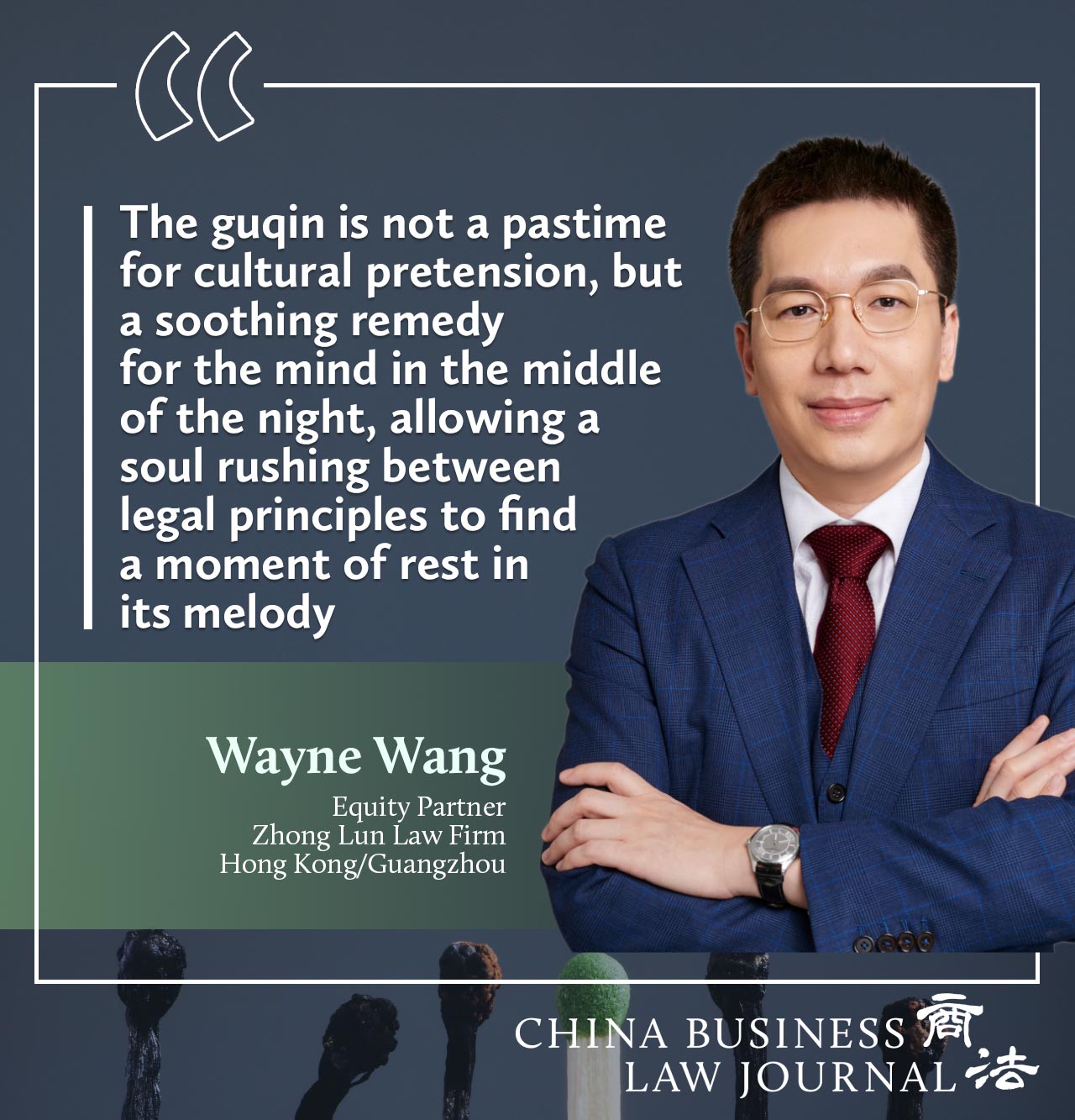
“The guqin is not a pastime for cultural pretension, but a soothing remedy for the mind in the middle of the night, allowing a soul rushing between legal principles to find a moment of rest in its melody.”
You must be a
subscribersubscribersubscribersubscriber
to read this content, please
subscribesubscribesubscribesubscribe
today.
For group subscribers, please click here to access.
Interested in group subscription? Please contact us.