





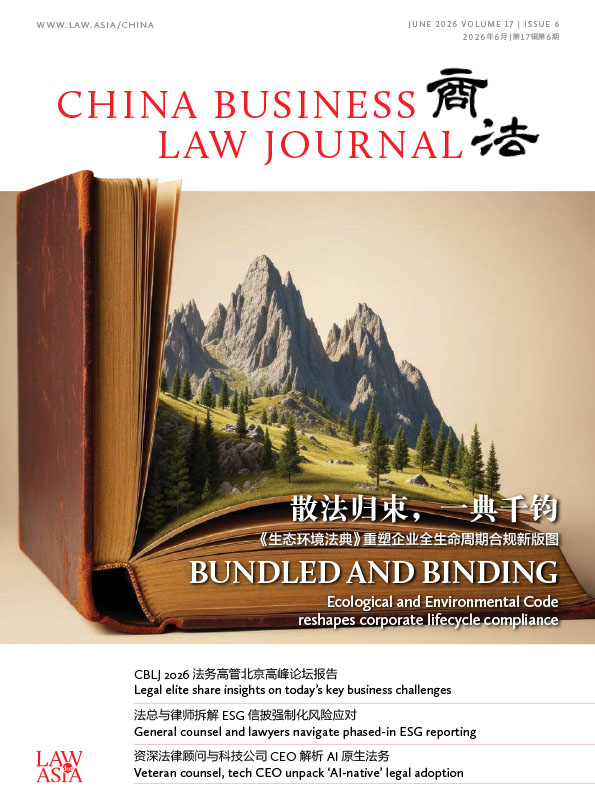


China Business Law Journal – May 2026
Volume 17, Issue 5
Subscribers can sign in to access the following PDF.
You must be a
subscribersubscribersubscribersubscriber
to read this content, please
subscribesubscribesubscribesubscribe
today.
For group subscribers, please click here to access.
Interested in group subscription? Please contact us.
你需要登录去解锁本文内容。欢迎注册账号。如果想阅读月刊所有文章,欢迎成为我们的订阅会员成为我们的订阅会员。
Highlights:
Eyes on the prize
China’s capital markets are changing gear. On the one hand, stock exchanges are opening their arms to high-potential startups from emerging tech-driven sectors. Regulators also voiced their explicit support for structural expansions accommodating hard tech IPOs during the 2026 Lujiazui Forum, signalling an optimum listing window for AI, semiconductor, commercial spaceflight and other high-growth sectors. On the other hand, regulatory standards have by no means been relaxed. On the contrary, the focus of scrutiny has expanded from the traditional issuer qualification to the sponsoring quality of intermediaries. In both Hong Kong and the Chinese mainland, regulators are setting their goals on the well-being of long-term capital markets by enhancing intermediary accountability and corporate governance.
Our cover story, No flaws allowed, examines the duality of the appeal and the harsh scrutiny that define China’s capital markets this year, with particular focus on how issuers and listed companies can navigate the new challenges. Last year, Hong Kong’s IPO market saw explosive growth with the number of new listings rising by more than 60% and total funds raised surging by more than 220%.
However, rapid market expansion had the side effect of exposing holes in the quality of sponsor services and listing documents. The Securities and Exchange Commission has demanded that sponsors immediately improve the quality of prospectuses and enquiry responses, as well as addressing the issues of overburdened IPO principals and shortage of qualified personnel. The A-share market proves no less harsh, with rapid new regulations on board secretary duties, disclosure and short-swing transactions pushing listed companies to improve their governance and efficiency.
Similarly, parties to international disputes need to step up their comparative knowledge on seats of arbitration. While a favourable verdict at a court or arbitral tribunal always feels satisfying, there is little value if it cannot be reliably enforced in the destined jurisdiction and translated into financial restitution. This makes the selection of the dispute arena, which in arbitration manifests as the arbitration seat, a critical first step.
In A tale of three seats, Marco Chung, group head of legal at Citic Securities International, lists the pros and cons of three popular seats for international arbitration: Hong Kong, Singapore and London. In particular, at least where China-related parties are concerned, he weighs up the most logical choice when taking into account enforceability, impartiality and statutory support.
Finally, after months of extensive market research, we are excited to unveil the winners of our In-house Counsel Awards 2026. The awards are presented to the most outstanding legal teams and their leaders for their highly commended performances across various practice areas and industry sectors in the past year, helping their companies navigate through generational industry restructuring and global regulatory uncertainties.
We offer our sincerest thanks to all who participated in our market survey and a hearty congratulations to all the winners.
In this issue

Unwinding red-chip structures
This practical guide covers tax exposure, distinct exit paths for VIE and direct equity structures, and five regulatory red flags that determine IPO success.


A tale of three seats
For Marco Chung, group head of legal at CITIC Securities International, the choice for arbitration seat in China-related disputes is clear











In-house Counsel Awards 2026
Following months of market research, we have selected these outstanding in-house counsel and their teams