





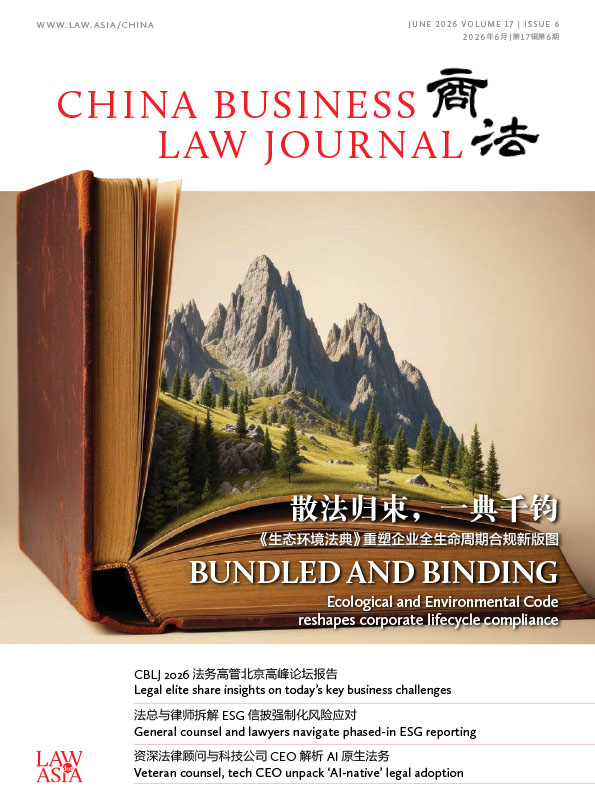


To celebrate IWD, CBLJ speaks to three women in law who have pierced through barriers to advance their careers
The barrier cannot be seen, yet it is still unmistakably there. It stretches between ambition and authority – silent as glass, hard as iron. Countless women, climbing the long ascent of their careers, have looked up at it, reached for it, even pressed against it – yet not all have managed to break through.
In China’s legal profession, the ranks of female lawyers have grown steadily in recent years. But when the lens shifts to law firm management, general counsel offices and other centres of decision-making power, the scales of gender equality remain uneven. The invisible structure known as the “glass ceiling” still hovers over the final mile of women’s professional ascent.
On International Women’s Day 2026, we speak with three women in law who have pierced that ceiling. They lead complex mandates, guide teams and help shape institutions. In their respective arenas, they answer doubt with competence and pressure with resilience.
Their journeys differ, yet they point in the same direction: carving out space of their own beyond walls constructed by quiet bias.
China’s legal industry was long dominated by men. In 2008, Chen Shu, then secretary-general of the Guangzhou Lawyers Association, revealed in an interview as a deputy to the National People’s Congress that women accounted for only about 25% of the profession at the time.
During the next decade, the gender balance has quietly shifted. The 2025 China Business Law Journal survey of 130 domestic law firms found that female lawyers now outnumber their male counterparts, at a ratio of nearly 10 to 9. At the equity partner level, however, the balance remains male-dominated, at roughly 9 to 5.
Hong Kong has followed a similar trajectory. According to statistics from The Law Society of Hong Kong, the proportion of female solicitors rose from 16% in 1983 to 52% in 2023, reaching parity and even surpassing it. Yet in a 2020 media interview, then-president Melissa Pang acknowledged that female representation at partner level was “not high”.
She was the first woman to lead the Law Society since its establishment in 1907.
Behind the numbers lies a lived reality: the door may be open, but the summit remains elusive. As more women enter the legal profession, why do so few reach the top?
HKEX Head of Listing Katherine Ng
As head of listing at HKEX, Katherine Ng leads hundreds of professionals overseeing the roster of companies listed on one of the world’s most important international exchanges. In 2025, HKEX ranked first globally in IPO fundraising, with 119 new listings – a remarkable year for the listing division.
Ng’s career has unfolded across multiple terrains. She began as a lawyer in London and Hong Kong with Linklaters, before moving on to serve as managing director in the legal department at Merrill Lynch and later as political assistant to the Secretary for Financial Services and the Treasury in the Hong Kong government.
She joined HKEX’s listing division in 2013. The convergence of these roles – private practice, investment banking and public service – ultimately forged the depth and breadth of her regulatory perspective.
Reflecting on her decision to leave private practice, Ng said that over time she realised that compared to transactions themselves, she was more drawn to how law shaped markets. “That curiosity took me into investment banking, and then to government, which proved to be a pivotal moment.”
Shortly after joining the Hong Kong government in 2008, she found herself confronting the full force of the global financial crisis. The experience offered a close view of how policy, politics and markets intertwine in practice – and reshaped her understanding of regulation and impact.
“When I began my career in capital markets roles, there were few female role models at senior levels. That made me more aware, but also helped me develop resilience and strengthened my conviction that diverse perspectives enhance leadership,” Ng said.
GC Michelle Hung at COSCO Shipping Ports
If Ng’s story reads like an ever-expanding cross-sector map, Michelle Hung’s career at COSCO Shipping Ports resembles a chronicle written over nearly three decades — steady, deliberate and anchored in institutional memory.
Hung has served as general counsel of COSCO Shipping Ports since 1996. Starting from scratch, she built the company’s entire legal function. In 2024, she received the Lifetime Achievement Award at China Business Law Journal’s House Impact Awards.
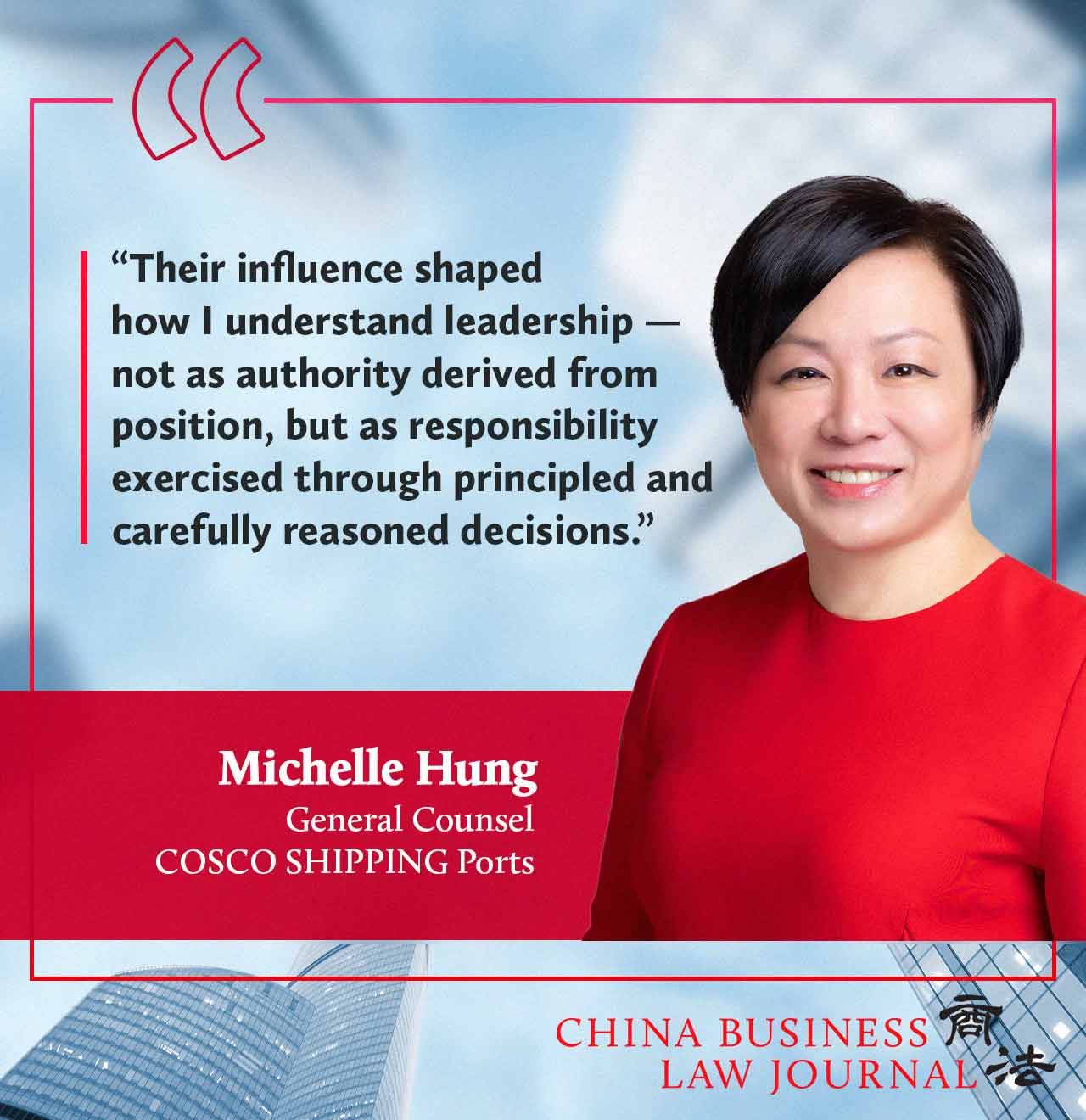
Speaking of mentorship, she said learning from seasoned leaders shaped her profoundly: she observed how they weighed competing priorities and took responsibility for difficult decisions.
Equally formative was their emphasis on discipline. “Precision in analysis, clarity in communication and consistency in standards” were, she said, “treated as expectations, not aspirations”. Over time, those disciplines became internalised and formed the basis of how she approaches her role.
“Their influence shaped how I understand leadership – not as authority derived from position, but as responsibility exercised through principled and carefully reasoned decisions.”
Looking back on nearly 30 years as general counsel, Hung believes adaptability has been another key factor. Regulatory frameworks and market expectations have transformed dramatically over the decades, alongside the company’s expanding global footprint. “That balance – between rigour and progress – is demanding, but it’s also what makes the work meaningful.”
Jingtian & Gongcheng senior partner Liu Honghuan
From Hung’s steady accumulation of experience, we turn to Liu Honghuan, senior partner at Jingtian & Gongcheng, whose professional temperament reflects a different kind of strength. If Hung’s defining quality is endurance, Liu’s is judgement – honed in decisive moments.
With more than 30 years in dispute resolution, Liu has handled countless complex commercial litigations and arbitrations. Before rejoining Jingtian & Gongcheng, she built and led the dispute resolution team at Baker McKenzie FenXun. Earlier in her career, she headed the litigation and arbitration department at Zhong Lun Law Firm and served as a partner at JunHe.
Prior to entering private practice, she worked in the Economic Division of the Beijing High People’s Court, focusing on trial supervision.
“Entering the court system was an assignment under the planned economy. But choosing law school was a decision I made for myself,” Liu recalled. From the outset of her legal career, she set her sights on dispute resolution – “because it is complex, and because it is fascinating”.
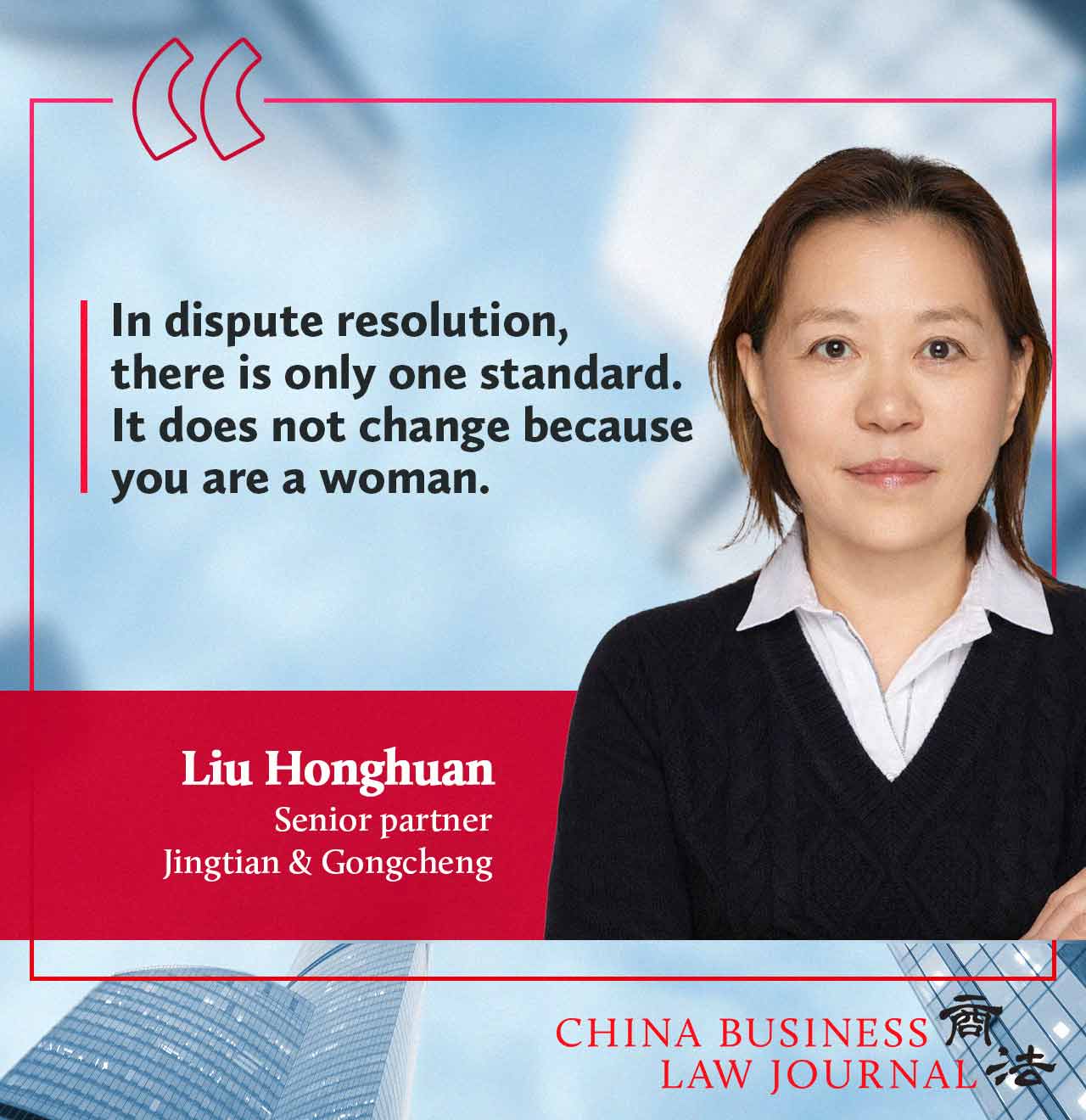
She speaks candidly about the intensity of the work. It is the thrill of it that keeps her there. Dispute resolution demands rapid judgement amid incomplete information and structural complexity. For Liu, decisions made under pressure bring not anxiety but exhilaration.
“Looking back over more than three decades of practice, what shaped me most was not any single landmark case, but the recurring moments of judgement – how to remain clear-headed within complex structures,” she said. “Very often, appearance and reality diverge. Procedure can become a tool and rules can be exploited.
“Having witnessed these tensions and negotiations, my understanding of ‘justice’ has become more concrete. It is not an abstract ideal, but the effort to move as close as possible to fairness within real-world structures.”
She added, “These experiences gradually shaped my professional style. I establish the narrative of a case through the intersection of legal norms and fact-finding, then deconstruct the interest structure, reconstruct the risk landscape, and finally arrive at a judgement.”
You must be a
subscribersubscribersubscribersubscriber
to read this content, please
subscribesubscribesubscribesubscribe
today.
For group subscribers, please click here to access.
Interested in group subscription? Please contact us.