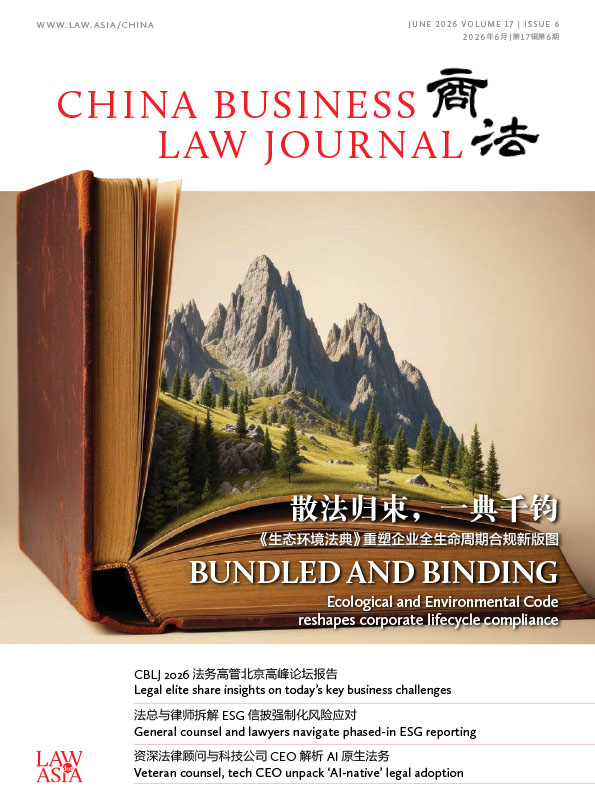








Changes to the Maritime Code are under scrutiny as tensions escalate in the Strait of Hormuz. How will its latest revisions assist the flow of global seaborne trade? Olivia Wang reports
From the “Maritime Silk Road” of the Han dynasty, to Zheng He’s voyages in the Ming era, and onward to the European Age of Discovery that reshaped the global political and economic order, humanity has never ceased forging commercial routes across the vast oceans.
Confronted with commercial demand and the the unpredictability of the seas, maritime laws have emerged as a necessary framework.
China’s first Maritime Code was promulgated in 1992. More than 30 years later, the first revision of the Maritime Code was formally adopted on 28 October 2025, and took effect on 1 May 2026.
The overhaul has been described by practitioners as “transformational” in its scope and comprehensiveness. It aligns domestic provisions with international rules and codifies judicial practices that have already taken shape in the courts, while also seeking to strengthen China’s legislative voice in the development of international maritime rules.
But as geopolitical currents unsettle waterways, what impact will the revised Maritime Code have on trade, shipping and the maritime industry?
Civil Code to Maritime Code
When discussing the most significant change brought about by the latest revision, one theme repeatedly emerges: maritime transport between domestic ports has finally been brought within the scope of the Maritime Code. This is widely regarded as one of the most substantive breakthroughs of the current overhaul, bringing an end to the longstanding regulatory divide between coastal and international shipping, and establishing what the industry calls terms a “minimal dual track” regime.
Prior to the amendment, domestic coastal carriage was governed solely by the Civil Code, under which carriers could not rely on nautical fault as a defence. The revision to chapter 4 of the Maritime Code removes the clause excluding carriage of goods by sea between ports of the People’s Republic of China , subjecting both international and domestic sea carriage to the Maritime Code. Domestic carriers may now invoke defences such as nautical fault and fire, and benefit from statutory limitations of liability per package or unit.
In‑house counsel, likewise, recognise the importance of this change. Alain Wu, Asia senior counsel at global freight forwarder CH Robinson in Shanghai, observes: “In our view, the changes to chapter 4 are particularly significant, as they directly affect risk allocation under carriage contracts, and have important implications for insurance management and contract template design.”
Regarding the complexity of the changes, Li Chenbiao, a partner at Zhong Lun Law Firm in Shanghai, identifies the most immediate transitional risk as a “fundamental conflict of liability regimes”, noting that the divergence “will directly lead to disruptive changes in the rights and obligations of the contracting parties”.
Li says: “For domestic maritime transport businesses currently in transition between legal regimes: first first, both carriers and cargo interests should immediately conduct a comprehensive review of cross regime contracts and outstanding claims, and establish dedicated records; Second second, they should enter into supplemental agreements to clarify that voyages completed before 1 May remain governed by the Civil Code, or by other laws and regulations previously agreed in the contract; and Third third, with respect to cargo damage claims arising within the past year, formal demand letters should be issued without delay, and for existing claims, steps should be taken promptly to interrupt the limitation period.”
Another maritime lawyer, Mervyn Chen, senior partner and managing director of Wintell & Co in Shanghai, offers tailored recommendations for both sides. For shippers, he suggests: “First, reviewing high‑value cargo and declaring cargo value in transport documents for new voyages, thereby lawfully breaking through statutory limitation caps; and second, consulting brokers to increase domestic cargo insurance limits to narrow potential exposure gaps.”
For carriers, Chen encourages what he terms calls the “dividend” of the new law. He recommends notifying domestic cargo clients and issuing supplemental agreements, while updating the paramount clause on standard domestic bills of lading and waybills to state explicitly that voyages commencing on or after 1 May 2026 are governed by the revised Maritime Code.
“Both parties must reach written consensus on how to determine the timing of incidents occurring during the transitional period, in order to construct a lawful firewall for liability allocation,” he says.
Shifting to a systematic level, Yan Bing, a partner at AnJie Broad Law Firm in Shanghai observes: “The ‘minimum dual track’ system seeks, to the greatest extent possible, to harmonise the legal regime governing domestic and international contracts of carriage by sea. Following the revision, many of the provisions in chapter 4 now apply to coastal transport. However, differences remain in the standards of carrier liability, particularly in respect of regarding the duty of seaworthiness, the duty of due dispatch, and the statutory fault based defences.
“The bill of lading regime may now apply in coastal transport scenarios. Parties engaged in domestic trade may structure their arrangements according to their commercial needs, while benefiting from the institutional convenience afforded by negotiable transport documents.”
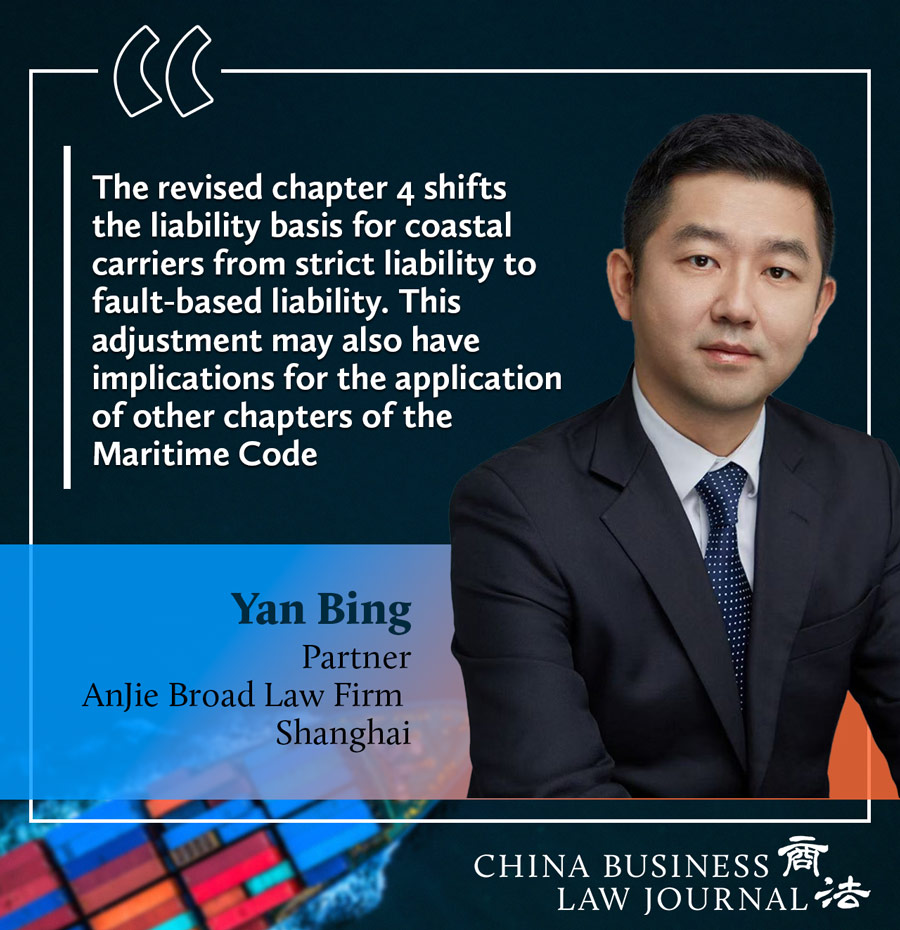
Yan adds: “The revised chapter 4 shifts the liability basis for coastal carriers from strict liability to fault‑based liability. This adjustment may also have implications for the application of other chapters of the Maritime Code. For example, the general average regime may assume a more prominent role in the context of coastal transport.
“The distinctive feature of the law governing contracts for the carriage of goods by sea is that it mandates a minimum standard of carrier liability, while allowing the parties to agree to a higher standard. In other words, it still leaves room for dominant shippers to mitigate the impact of the new law through contractual arrangements.”
You must be a
subscribersubscribersubscribersubscriber
to read this content, please
subscribesubscribesubscribesubscribe
today.
For group subscribers, please click here to access.
Interested in group subscription? Please contact us.
你需要登录去解锁本文内容。欢迎注册账号。如果想阅读月刊所有文章,欢迎成为我们的订阅会员成为我们的订阅会员。