






As Chinese companies graduate from contract manufacturing to proprietary brands and technology exports, the intellectual property rules originally written for the ‘world’s factory’ are undergoing an upgrade. Pan Xinyi reports
At a gas station in California, a knockoff figurine nicknamed “Lafufu” by netizens sits by the checkout, priced at USD4.99. It shares a face with Labubu, a viral designer toy from Chinese brand Pop Mark, and in all likelihood may share a production line in Dongguan, China. Counterfeiting long ago ceased to be a local night-market tale; it has become a structural byproduct of China’s supply-chain efficiency, leaking silently across the globe.
This is no isolated case. When Chinese factories begin to build their own brands and technologies, the intellectual property (IP) map drawn for the era of original equipment manufacturing no longer charts the waters they sail today.
What China is undergoing is not a moral awakening, from infringer to rights holder, but a system-wide upgrade driven from within. As industry climbs the value chain, as AI front-loads risk into the very first line of code, as companies venturing abroad repeatedly hit the high, well-guarded patent walls of mature markets, the domestic institutional foundations underpinning this contest still bear the casting marks of two decades ago.
The core IP framework of China took shape around the country’s accession to the World Trade Organisation, designed to serve an export-led economy, secure trade access, and attract foreign investment. Its centre of gravity was rapid rights registration, not innovation incentives.
Today, China has moved from contract manufacturing to home-grown innovation. According to WIPO’s Global Innovation Index 2025, it has for the first time broken into the top 10, the only middle-income economy in the top 30. Yet the framework remains largely unchanged.
Pressure is showing up everywhere. China’s National Intellectual Property Administration reports that trademark applications exceeded 6 million, with examination cycles compressed to four months. However, Marks & Clerk, a UK IP firm, notes that to keep up the speed, the examination authorities have leaned heavily on assistant examiners, and inconsistencies in standards and rising refusal rates have followed.
The judicial side is under equal strain. In 2025, the Supreme People’s Court’s Intellectual Property Tribunal awarded punitive damages in 30 cases, totalling about RMB1.13 billion (USD165.6 million), more than half the cumulative sum in the tribunal’s seven-year existence.
Yet China’s punitive damages regime has only been rolled out gradually since 2019, and remains in a phase of adaptation and refinement; calculating damages is complex, and the criteria for application are still not fully clear. At a time when judicial protection has greatly intensified, adjudication is only growing harder.
The IP system built for the world’s factory is being stretched out of shape by its very users. From trademarks to trade secrets to patent commercialisation, the mismatch between old maps and new terrain points to a single question: now that IP has evolved from a passive compliance accessory into infrastructure for global competition, should companies continue to follow the existing chart, or draw their own course?
Trademark: use it or lose it
Close to 50 million active trademarks sit on China’s register, a substantial share of which have never been genuinely used. This is not a hallmark of market vitality, but the institutional reckoning for decades of prioritising registration over use. The current revision of the Trademark Law takes direct aim at this deep-rooted malady.
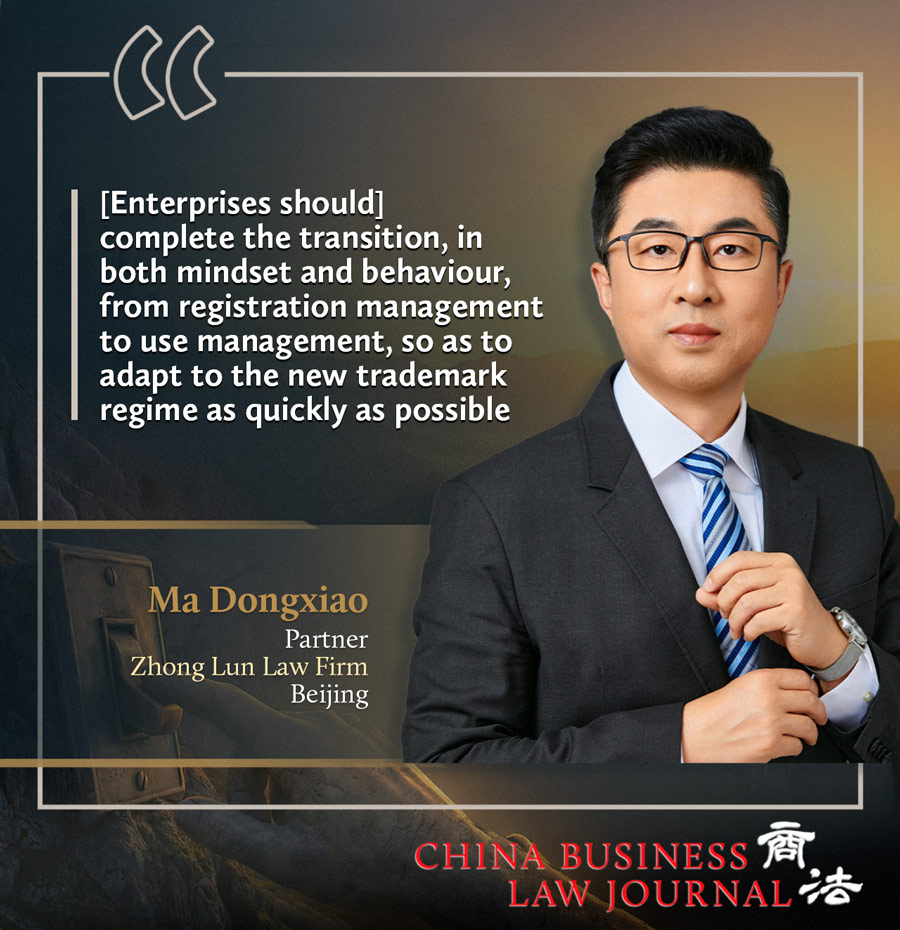
Ma Dongxiao, a Beijing-based partner at Zhong Lun Law Firm, distils the core logic of the revision as a systemic shift from “registration first” to “use first”. He notes that for the draft revision, three fronts advance in parallel, each targeting a stubborn malady: hoarding; drawn-out timelines; and irregular use.
On the registration side, a dedicated new chapter requires a return to the original purpose of use and curbs hoarding that exceeds normal business needs. On the procedural side, shortened opposition periods and a new “suspension of examination” mechanism address the wheel-spinning caused by changed circumstances. On the administrative side, compliance obligations on trademark agencies are simultaneously tightened.
For businesses, the most immediate shock falls on existing portfolios. Ma believes that stockpiled defensive trademarks will face a dual test of “intent to use” and “normal business need”, and that companies must “complete the transition, in both mindset and behaviour, from registration management to use management, so as to adapt to the new trademark regime as quickly as possible”.
The central question of trademark stewardship is thus shifting from securing rights to building a watertight chain of evidence.
The institutional correction has another target squarely in its sights: the shadow industry of profiteering through registration and litigation. Zhang Jian, a Beijing-based partner at Han Kun Law Offices, points out that the draft revision upgrades the regulation of bad-faith squatting for the first time, moving beyond a single track of “administrative rejection or invalidation” to a dual-track remedy of “administrative fines plus civil damages”.
Victims of squatting can now file civil suits for compensation directly, transforming the economic calculus from near-costless rejection to the prospect of fines and damages combined.
Beyond squatting, abusive litigation is also in the crosshairs. The draft introduces a counter-compensation clause, making explicit that parties who maliciously initiate trademark litigation causing losses to others shall bear civil liability, a provision that takes direct aim at shakedown-style lawsuits brought purely for profit.
Beyond remedying old ills, the regime is also clearing a path for new realities. Hatty Cui, the general manager of China at Rouse in Beijing, notes that the draft proposes to bring dynamic marks into the fold of registrable trademark types, responding to the evolution of brand expression in the age of short video and AI.
She advocates for a design philosophy of “broad admission, strict delimitation, allowing more new types of marks to gain registration at the gateway, while applying rigorous scrutiny to the boundaries of their rights”. The approach is pragmatic but far from straightforward. Assessing the distinctiveness and stable presentation of dynamic marks is considerably more complex than for conventional trademarks, and the difficulty of establishing and proving rights climbs in tandem.
Another proposed amendment has sparked wider debate. The “not for the purpose of use” clause now drops the “bad faith” qualifier, casting the regulatory net appreciably wider. Cui cautions that, without clear criteria for differentiation, a net wide enough to catch hoarding applications may also snare legitimate defensive filings. The regime, she argues, must “strike a balance between ‘emphasising the use attribute’ and ‘respecting normal business arrangements’”.
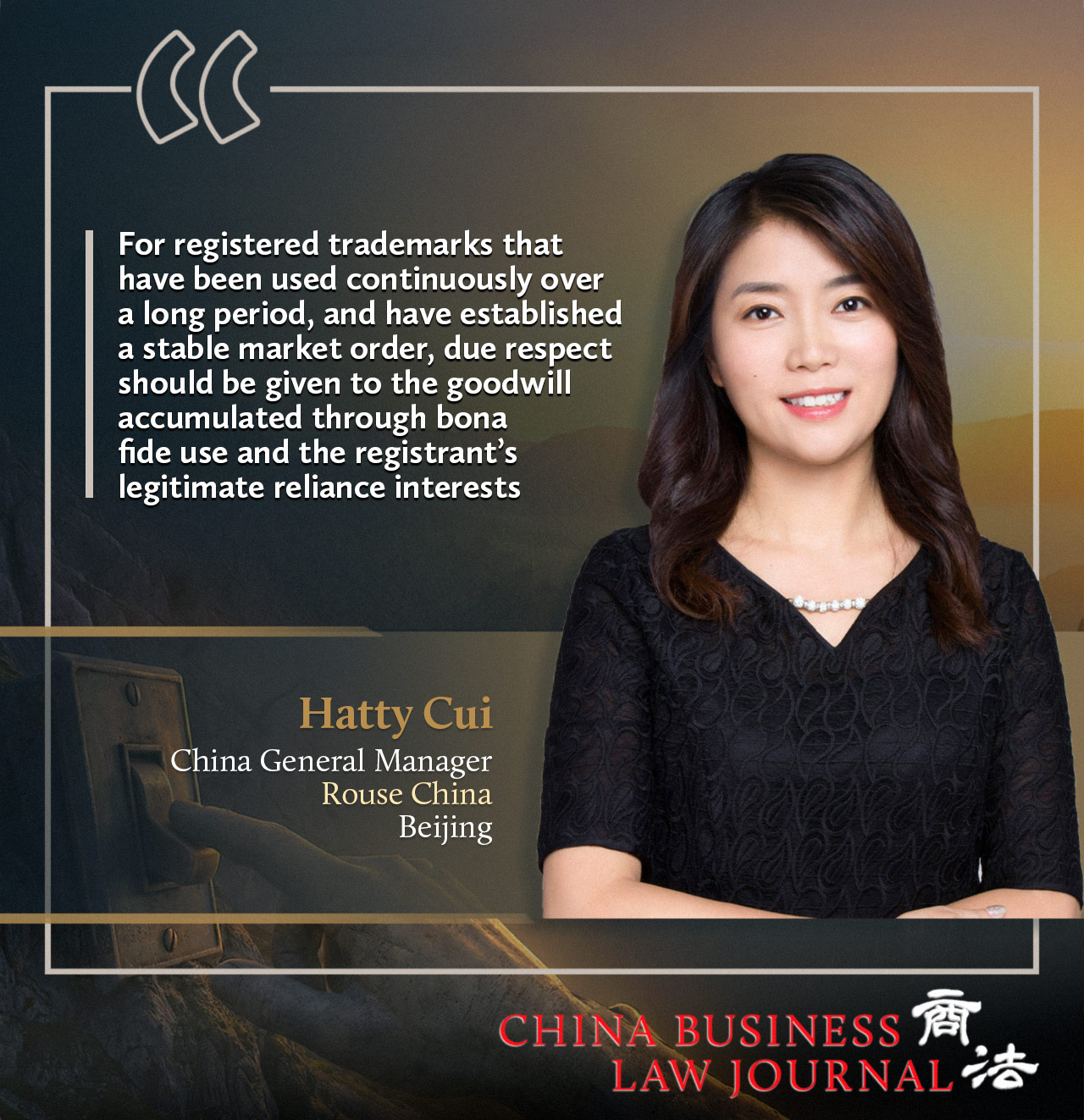
The direction of the trademark cleanup is clear, but where exactly the line falls between hoarding and legitimate reserves matters just as much. Cui suggests that “for registered trademarks that have been used continuously over a long period, and have established a stable market order, due respect should be given to the goodwill accumulated through bona fide use and the registrant’s legitimate reliance interests”.
Even as the regime accelerates its course correction, it must preserve a sense of security for those who have played by the rules. The leap from a registration mindset to a use mindset is ultimately a test not just of force, but of finesse.
You must be a
subscribersubscribersubscribersubscriber
to read this content, please
subscribesubscribesubscribesubscribe
today.
For group subscribers, please click here to access.
Interested in group subscription? Please contact us.
你需要登录去解锁本文内容。欢迎注册账号。如果想阅读月刊所有文章,欢迎成为我们的订阅会员成为我们的订阅会员。
Practitioner’s Perspective Article Series
Compensation not contingent upon actual sale in patent infringementBy Guo Xiaojun, CCPIT Patent & Trademark Law Office |
 |
Protection of non-traditional trademarks in ChinaBy Wang Xiao and Kelly Liu, Tahota Law Firm |
 |