





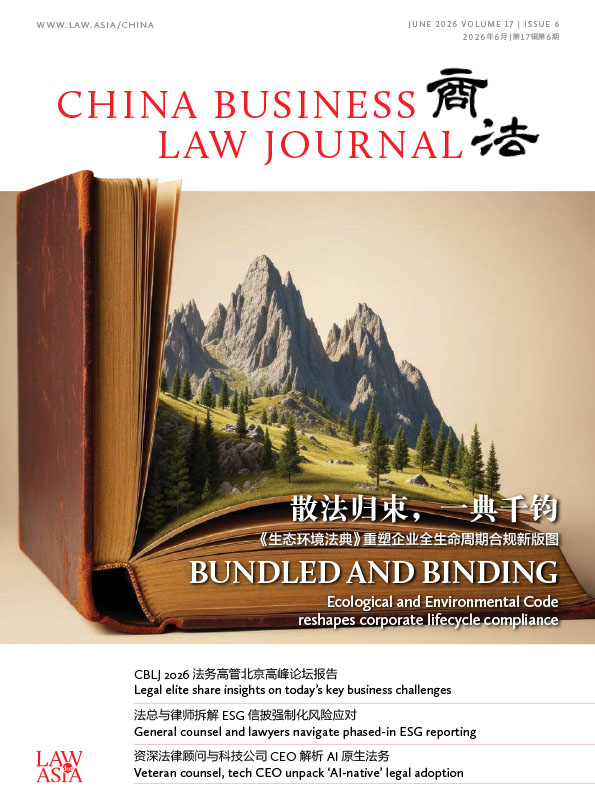


China Business Law Journal – June 2026
Volume 17, Issue 6
Subscribe now to read China Business Law Journal in full and unlock our full archive and a vast resource of legal intelligence.
Highlights:
- Bundled and binding: Ecological and Environmental Code reshapes corporate lifecycle compliance
- Legal elite share insights on today’s key business challenges
- General counsel and lawyers navigate phased-in ESG reporting
- Veteran counsel, tech CEO unpack ‘AI-native’ legal adoption
- Lexicon: State-funded companies and corporate governance
Reading the currents, steering change
Some shifts come from without: laws redraw boundaries and accountability reaches deeper into management. Others begin within: technology rewrites workflows and organisations redefine human-machine roles. Together, they confront in-house legal teams with more than new rules, demanding a wholesale redesign of compliance and ways of working.
This issue’s cover story, Bundled and binding, focuses on the Ecological and Environmental Code, taking effect on 15 August 2026. Bringing scattered rules into one code goes beyond consolidation. It unifies pollution control, ecological conservation, and green and low-carbon development, while tightening links between administrative, civil and criminal liability.
Corporate obligations will extend beyond pollution controls and end-of-pipe treatment to the full lifecycle of projects and products. Under a tougher dual-penalty regime, management will find it harder to plead ignorance. Companies must embed environmental responsibility in governance and operations.
Environmental responsibility goes beyond operational compliance. For A-share companies moving into mandatory sustainability reporting, green data and commitments fall within the verification and accountability regime for securities disclosure. Green: Seen it or mean it? considers how the boundaries of corporate responsibility are shifting, and how companies must respond, as mandatory ESG disclosure is phased in.
Where green claims may influence investment decisions or supply-chain access, companies must show such claims are credible and backed by substantiated data, sound methods and traceable procedures. In-house counsel must move upstream to shape data governance, disclosure controls and mechanisms for directors, supervisors and executives to discharge their duties.
As external constraints tighten, capabilities must keep pace. Going ‘AI-native’ argues that adopting generative AI is only the start. Becoming AI-native means treating AI not as a bolt-on, but as the basis for redesigning task allocation, knowledge capture, access and accountability, and performance assessment. Without that shift, individual gains may not translate into organisational capability, while shadow AI, data leaks and audit-trail gaps proliferate. For GCs, this is organisational redesign, not tech adoption alone.
Reshaping the legal department builds strength from within; selecting outside counsel shapes how external expertise is brought to bear. Drawing on a CBLJ survey, Choosing ideal lawyers finds that track record, service consistency and price rank the highest. Behind the ranking lie industry understanding and practical fit, sustained commitment, and fees that equate to value delivered.
Navigating these converging forces is a shared challenge for market participants. On 26 June, CBLJ Forum Beijing 2026 brought together more than 70 legal experts and industry leaders to discuss international expansion, capital transactions, dispute resolution, anti-fraud, AI, intellectual property, securities litigation and data assets. This issue’s forum report distills their first-hand insights for companies building legal resilience.
In this issue

Bundled and binding
Ecological and Environmental Code reshapes corporate lifecycle compliance

Former Yingke senior partner and IP team of 10 join Riying
Chen Chen, former senior partner at Yingke’s Shanghai office, joins Riying at its Shanghai headquarters along with his team

Sidley signs up former Ashurst HK dispute resolution head
Sidley Austin hires James Comber, the former head of Hong Kong dispute resolution practice at Ashurst, as a Hong Kong partner













CBLJ Forum Beijing 2026
More than 70 legal experts and industry leaders shared insights at our Beijing forum, exploring solutions to businesses’ key legal challenges