












China’s new environmental code bundles decades of separate statutes into one heavy tome, and companies are scrambling to decipher chapter and verse. Luna Jin reports
A RULING HANDED DOWN in June 2025 by the Jiujiang Intermediate People’s Court, in Jiangxi province, brought a long-running pollution case to a close. Two years earlier, Yan, a deputy chief at a Jiangxi-based industrial company, had paid unlicensed contractors RMB420 (USD62) a tonne to dispose of hazardous liquid waste produced by a pharmaceutical company it controlled. Some 3,228 tonnes of corrosive effluent ended up dumped near a national aquatic germplasm reserve for the four major Chinese carp species on the Jiangxi stretch of the Yangtze River, killing aquatic life and badly damaging surface water.
The pharmaceutical company and 20 individuals, Yan among them, were ultimately convicted of environmental pollution. The company was fined RMB300,000; the four ringleaders drew prison sentences of between three years, and four years and eight months. The court separately ordered the two companies and others jointly to pay RMB19.3 million in ecological restoration costs, and a further RMB756,000 for an emergency clean-up.
A RMB300,000 criminal fine, almost RMB20 million in restitution and 20 criminal convictions: such is the latest portrait of China’s “three-pronged” approach to environmental wrongdoing – administrative, civil and criminal all at once. The case was released jointly by the Supreme People’s Procuratorate and the Ministry of Ecology and Environment on the eve of something more structurally significant.
On 15 August 2026, China’s first Ecological Environment Code will take effect, superseding provisions hitherto scattered across more than 10 free-standing statutes. Pollution control, ecological protection, and a newly minted green and low-carbon development book will henceforth form a single, interlocking whole.
For Chinese companies, this is a watershed. For decades they have faced a patchwork of standalone statutes that could be tackled piecemeal; from now on every clause is bound between the same covers, and tugging at one strand pulls the whole. The lawyers tasked with translating this into client memos put it more bluntly: many clients have yet to grasp that bundled rods are harder to snap than scattered ones, and that when they come down, they hit harder.
In-house counsel and environmental lawyers converge on a single theme: the months between now and August 2026 are not a grace period, but a stress test.
One law overhead
The code runs to more than 1,200 articles arranged in five books. The structure alone creates its most awkward problem: rolling up more than 10 separate statutes looks like mere tidying up, but it touches the legal basis and outer limit of every environmental duty a company bears.
Wu Qing, a partner at the Guangzhou office of King & Wood, identifies three shifts that businesses must digest before the code takes effect. The legal basis itself, she notes, has been rewritten. “The code adopts a ‘moderate codification’ model, producing a ‘dual source’ arrangement in which the code coexists with the standalone statutes,” she says.
“This poses no small challenge for businesses trying to identify and understand the applicable law in their environmental compliance work.” In the past, every category of pollutant had its own dedicated statute; now the deceptively simple question of which rule applies has become thorny.
Second, the perimeter of corporate duty has been pushed both outward and forward. “Horizontally, companies must broaden their focus from pollution control alone to a trinity of pollution control, ecological protection and green low-carbon development,” says Wu. “Vertically, the code requires them to shift attention from discrete moments – getting approvals, meeting discharge standards – to whole lifecycle compliance covering construction projects and products.”
Third, and most consequential, the code marshals civil, criminal and administrative liability between the same covers, and sets out how they interlock. “It raises penalties for environmental wrongdoing across the board, and may lay the groundwork for novel kinds of litigation, exposing companies to a wider range of claims, with bigger sums at stake,” says Wu.
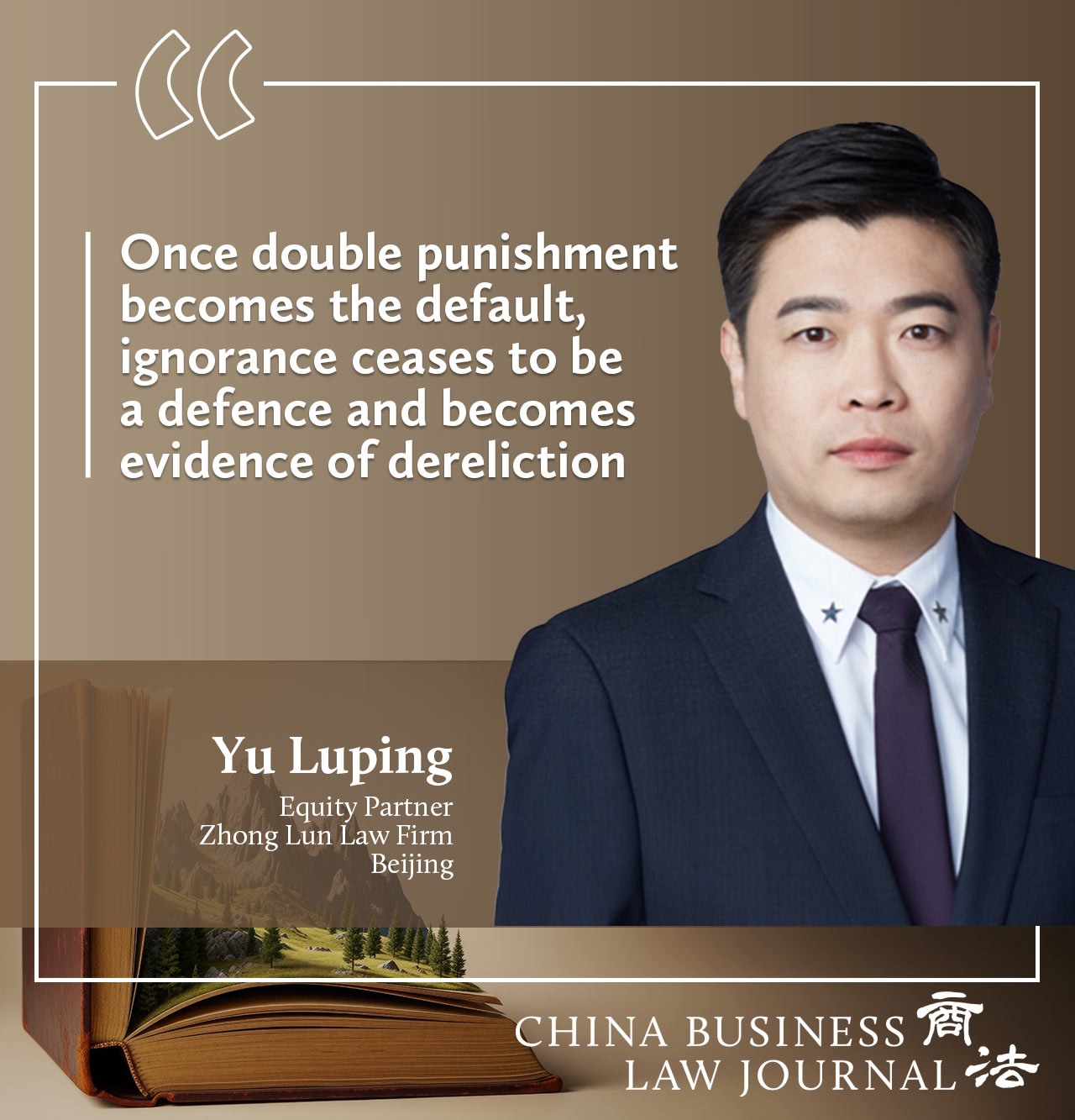
Beyond widening the regulatory net, the code will also rewire corporate organisation charts. Yu Luping, an equity partner at the Beijing office of Zhong Lun Law Firm, draws particular attention to a strengthened “double punishment” rule, under which companies and the individuals responsible are pursued in tandem.
“The scope of double punishment is widening, from four specified situations to any incident caused by an environmental breach,” says Yu. “The pool of those liable is also widening, taking in legal representatives, principal officers and other senior decision makers.”
Yu warns that this will force boards to reweigh risk against reward. “Once double punishment becomes the default, ignorance ceases to be a defence and becomes evidence of dereliction.”
Zou Kun, an equity partner in Zhong Lun’s Wuhan office, looks instead at how the code consolidates and rewrites the existing edifice. The pollution-control book alone, she notes, will retire 10 current statutes covering air, water, environmental impact assessment and solid waste, while new chapters on chemical risk management, electromagnetic pollution and light pollution address “areas where regulation was previously weak or absent altogether”.
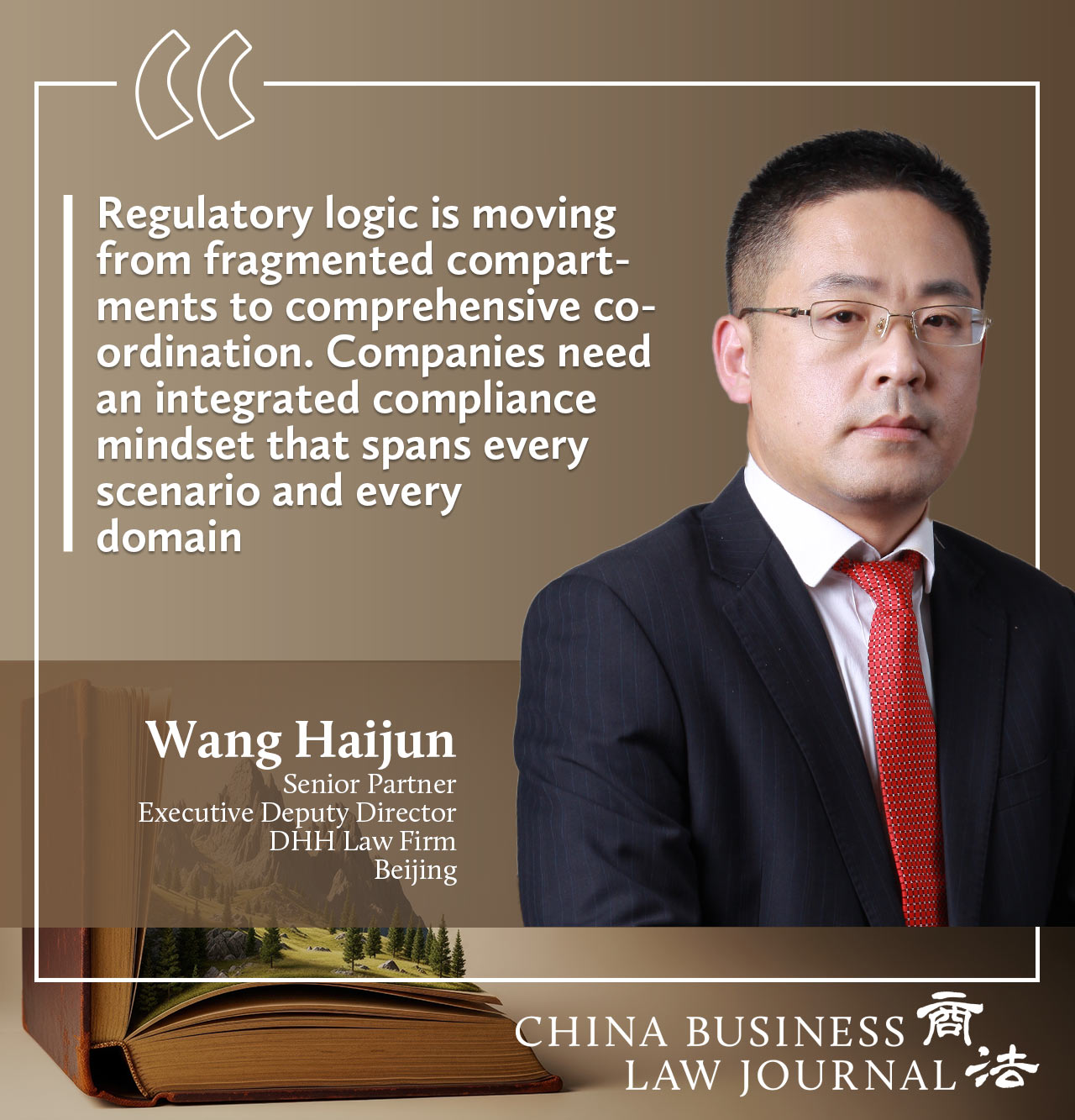
Wang Haijun, senior partner and executive deputy director at the Beijing office of DHH Law Firm, thinks the deepest shift required is one of mindset. “Regulatory logic is moving from fragmented compartments to comprehensive co-ordination,” he says. “Companies need an integrated compliance mindset that spans every scenario and every domain.”
The cost of breaking the law, in his view, is no longer confined to administrative fines but a “seamless coupling of administrative oversight, civil damages, ecological damage compensation and public interest litigation”.
Beyond horizontal integration, liability must also reach vertically into the boardroom. Liao Mingzong, a senior partner at the Shenzhen office of DeHeng Law Offices, distils the logic into a slogan: nail down responsibility at the top.
The chief executive, he insists, must be designated “first person responsible” for environmental matters. Compliance “should be embedded across the whole arc of business decision making, not bolted on after the fact”.
For chemicals companies, on the front line of industrial transformation, the shift in mindset cuts deeper still. Allen Jiang, general manager of the legal department at Sinochem International, says: “For the chemicals industry, the code’s coming into force means the old high-pollution, high-energy model is finished. Companies must use the code as a guide and transform deeply towards green, low-carbon and circular operations.”
They must, in his view, turn “green compliance into one of their core competitive strengths”. The code’s impact on the industry “marks not only an across-the-board tightening of state oversight but, in the longer run, the acceleration of a fresh round of shake-out”.
Wider net, sharper teeth
For years China’s environmental statute book has relied chiefly on administrative fines. Whether those fines truly outweigh the gains from breaking the rules, and whether they meaningfully deter larger companies, has been among the most debated and least settled questions of the past decade.
The code does not stop at adding zeros. While welding the three forms of liability together, it hands regulators and litigants a clutch of levers that were previously scattered.
Wang, of DHH, lists the risks companies must now juggle. The reach of ecological damage and public interest claims is “greatly broadened, with much stronger enforcement”; punitive damages have more triggers; companies may face “dual liability” in the form of administrative penalties alongside civil damages; and liability “can be pierced through to ultimate controllers and senior managers”.
Joint sanctions for breach and bad faith will also be stiffer. “Once a firm is implicated, it ripples through every stage of its business, from tendering to financing to day-to-day operations,” he says.
Wu, of King & Wood, sees litigation risk swelling on several fronts at once. The most immediate change concerns the threshold for launching ecological damage claims. When the regime was first piloted, it applied only to three categories of severe environmental harm. “The code no longer limits it to those three,” she notes. So long as a company’s environmental breach causes damage, “it may now trigger ecological damage litigation”. A procedure once reserved for the exceptional is sliding towards the routine.
More radical still, the code creates a fresh category of legal interest, ecological environmental rights, standing apart from personal and property rights. “The public may use this to bring all manner of new private environmental tort claims,” says Wu.
Drawing on overseas precedent, she warns that “novel claims with very large sums in dispute” may also follow. The code also pushes litigation into ecological protection and climate change. The relevant chapters, she adds, “may increase companies’ exposure to conservation suits and climate change suits”.
Not everyone is convinced the code raises fines. Chen Guoqiang, senior partner and head of environment and energy at the Hangzhou office of Capital Equity Legal Group, says: “I am not persuaded by the statement that the liability book ‘sharply raises the ceiling on fines’. It would be more accurate to say that many penalties have been set at more sensible levels; some have actually been lowered.”
Chen notes that, in drafting, penalty levels for long neglected fields such as radioactive pollution were “brought into line with those previously set out in the laws on water and air”.
He says that environmental public interest litigation may be reined in. “Existing law supports preventive public interest litigation. The most famous example is the ‘green peafowl case’, Friends of Nature v PowerChina Xinping (2020) – even where a project has not yet caused actual harm, prosecutors and NGOs can sue if a potential risk exists. On the current text, that kind of suit will be constrained. I see this as something of a step backwards.”
On ecological damage compensation, by contrast, Chen sees a welcome tightening. The code adds the qualifier “in accordance with relevant provisions”, and he hopes this will correct a current bias in practice towards “going down the compensation route regardless of the size of the damage”.
Zou, of Zhong Lun, warns that civil liability for ecological damage and for administrative liability are two different beasts. “Even where no administrative breach has occurred, actual pollution or damage to the environment can still trigger ecological damage compensation,” she says. Companies that refuse to negotiate “will face ecological damage litigation”.
Fines may be merely the tip of the iceberg. Jiang, of Sinochem, says the code for the first time writes into law that “the state shall build an ecological environment credit oversight system”.
This, he says, marks a turning point. “Environmental credit will no longer be merely a tool of the environmental authorities; it is now formally folded into the national social-credit framework, producing a cross-departmental, system-wide regime with full coverage.”
For companies, the hidden costs of an environmental breach are climbing fast. “A poor credit record will directly choke off financing channels, raising the cost and difficulty of borrowing,” says Jiang. “Beyond disrupting normal operations and business development, it will damage brand reputation and public image, and may set off a social media crisis.”
On top of double punishment, he says companies with chronically poor credit “may even be shut out of green supply chains, becoming the laggards and losers of the industry”.
What levers, then, can companies pull to limit the damage? The lawyers interviewed describe a well-trodden path through administrative proceedings or settlement talks: voluntary remediation, prompt elimination of harm, full ecological restoration, co-operation with enforcement, a first-time minor offence without intent, partial compliance already performed. “All of these can be evidenced in law to seek a lighter penalty, mitigation, or no penalty at all,” says Wang.
Yu suggests that companies can find defences in “the severity of the conduct and its consequences, the attitude towards rectification, remedial measures, causation, force majeure, and the victim’s intent or gross negligence”.
Liao says that companies can also “lawfully challenge enforcement procedures, monitoring data and forensic findings”.
However, Chen is less sanguine about how much the code itself arms defendants. “In my view it has the relevant provisions, but not much real substance. When companies hit practical problems, I would still suggest looking to the Administrative Penalty Law and the Measures for Administrative Penalties on Ecology and Environment for grounds.”
Building a compliance fortress
What the code leaves companies with is not merely a longer list of duties, but a tougher evidential climate. With the burden of proof tilted toward them, paper policies alone will not amount to a defence. The old rhythm of compliance, erect a system to satisfy inspectors, then scramble for a fix when something goes wrong, has run its course.
How, then, to rebuild it? Yu suggests advancing along three tracks: rules, execution and corrective response. On rules: “environmental responsibility should be written into senior managers’ job descriptions, training should be tiered for staff at every level, and decisions involving the environment should leave a documented trail”.
On execution, the discharge permit should be the master document: “Anchor everything to the ‘one permit’, let it govern compliance across the full life cycle and every element of environmental management.”
On correction, the line of defence must move forward: “Companies should shift from reacting to inspections to actively managing evidence, build an end-to-end record keeping system, and round out emergency arrangements and mandatory insurance.”
Wu says the starting line should be drawn earlier still. Companies, she says, should begin by taking fresh stock of the legal sources that apply to them. They must “re-map and identify the legal basis on which their environmental compliance work rests”, looking not only at the code itself but at “the amendment and repeal of laws, regulations, ministerial rules, normative documents and related judicial interpretations, standards and technical specifications” that remain in force alongside it, as well as “the enactment of dedicated legislation in fields such as climate change”.
She says compliance tools previously built around pollution control must be widened into “an all-round environmental compliance regime covering pollution control, ecological protection and green low-carbon development”. The new procedures must reach “every level of personnel within the firm”.
Xu Bin, a partner at the Beijing office of East & Concord Partners, reaches for an architectural metaphor to make a similar point. “Building an environmental compliance system is much like building any other corporate compliance system,” he says.
“First, set up the organisational structure and define the compliance roles, and the people responsible. Next, map the firm’s environmental obligations in full and embed them in its compliance and control processes. Then, in line with requirements, establish tiered controls and emergency plans, and strengthen compliance training and day-to-day culture. The goal is end-to-end, all-round compliance.”
On a daily footing he sets out three priorities: “First, be proactive – turn environmental compliance from a cost item into a non-negotiable business floor. Second, get data reporting and ledgers right, with proper data traceability. Third, treat energy saving and decarbonisation requirements as integral to the procurement, use and maintenance of core production equipment.”
Liao takes a more strategic view, arguing that the code’s “green orientation” can be turned to commercial advantage. “Push energy efficiency, decarbonisation, cleaner production and green industrial upgrading; standardise environmental disclosure; work with suppliers and customers to build a green supply chain. Done well, environmental compliance becomes long-term soft power and a competitive edge.”
How the new architecture lands may vary sharply by industry. Jiang sets out a checklist for chemicals companies: full-process dynamic management of discharge permits; an inventory-based regime for new chemical substances and new pollutants; dedicated posts for routine carbon-emissions accounting; tougher periodic surveys of soil and groundwater; and strict compliance with statutory disclosure of environmental information.
Her says legal teams should put discharge permit upgrades at the top of the queue. “It speaks directly to the compliance floor for operating at all. Getting it in place quickly helps companies head off fines, shutdowns and other regulatory and penal risk.”
For new-energy companies the pressure points are different. Lily Wang, senior legal manager at Shanghai Refire Group, describes a whole-life compliance system “spanning a project’s siting, construction, operation and decommissioning”. Environmental impact assessments must run alongside carbon assessments; pollution-control facilities must be designed, built and commissioned in lockstep with the main project, the so-called “three simultaneities”; during operations companies must “install online monitoring equipment, publish emissions data in real time and submit to regulatory oversight”.
Of particular note, the green and low-carbon development book “explicitly requires producers of new-energy products such as fuel cells to set up, in-house or through third parties, end-of-life recovery systems matched to their sales volumes, and to make this public”. Companies that fail to do so “face fines of up to RMB2 million, and may be ordered to halt production and dismantle the offending project”.
At the heart of any compliance system sits the discharge permit. Wang says the code elevates it from “a regime” to “the core” of fixed-source pollution oversight. The validity of discharge registrations has been cut to five years, “a clean break” from the previous indefinite model.
“Before a permit expires, companies must apply by law for renewal; continuing to discharge without renewal counts as discharge without a permit,” says Wang. During operations, day-to-day running and maintenance of the permit “become statutory record-keeping matters”.
“Companies must discharge in line with the permit, keep an accurate ledger and submit annual reports on time. In particular, the status of pollution control facilities is independent of whether actual discharge is taking place: if a facility is shut down, that must be reported through the proper channels.”
For Lian Tao, a director, deputy general manager and company secretary of Shandong Xinchao Energy, the immediate adjustments are more concrete. Xinchao is putting in place a layered defence: tighter ledgers for the segregated collection and disposal of solid wastes such as oily sludge and drill cuttings; an environmental credit early warning system that monitors breaches at home and abroad in real time; and a programme to compare compliance gaps between domestic and overseas operations and flag the risks.
Behind these defences sits a financial reality not to be underestimated. “Domestic banks and other lenders treat our environmental credit as a core input in their loan decisions,” says Lian. “A bad record means higher interest rates, smaller facilities, and potentially loans being pulled or cut off altogether.”
NO HIDING FROM CARBON
The most novel part of the code is its fourth book, on green and low-carbon development. For the first time, China’s “dual carbon” goals, peaking emissions before 2030 and reaching carbon neutrality before 2060, are written into ordinary legislation as a binding legal duty, rather than a mere policy aspiration.
The political signal is unmistakable. What it means in practice is less obvious. Many companies assume the book applies only to the eight sectors already covered by the national emissions trading scheme: power, steel, cement, aluminium, chemicals, petrochemicals, paper and aviation.
That reading tracks the actual trajectory of Chinese carbon governance over the past decade or so, which is why it is so widespread. Once the code takes effect, it would also be an expensive misconception.
“Elevating the dual-carbon goals into a legal regime means they are universal statutory obligations imposed on the whole of society, and on every market actor. There is no exemption for any class of subject,” says Xu Bin, a partner at the Beijing office of East & Concord Partners.
“Companies outside the cap-and-trade scheme are merely relieved of the specialised compliance duties, buying, surrendering and trading allowances. They are not relieved of the foundational duties: saving energy, cutting emissions and meeting mandatory efficiency standards.”
Carbon compliance, in other words, is inescapable. The traps most companies fall into, Xu warns, are procedural. Many assume that only energy-intensive projects need to clear energy conservation reviews and carbon assessments, but he notes: “any new build, retrofit or expansion must pass an energy and carbon admissions review”.
Even companies outside the cap may still be drawn in through the market. Yu Luping, an equity partner at the Beijing office of Zhong Lun Law Firm, identifies three indirect channels through which the code’s carbon duties will reach smaller companies. “Along the supply chain, customers’ compliance requirements may be written into suppliers’ contractual obligations. For instance, a requirement to use a certain proportion of green electricity,” he says, citing article 950.
Article 952, he adds, may turn product-level carbon-footprint management into “a market access threshold for export oriented companies”. Article 950 also implies that “energy saving, emissions reduction and resource recycling may become conditions for non-controlled companies to obtain finance”.
These vertical channels of transmission map onto a list of statutory duties that many companies have yet to audit. Wu Qing, a partner at the Guangzhou office of King & Wood, lists those most often overlooked: product lifecycle carbon footprint management; supply chain carbon transmission and green procurement; carbon emission accounting and ledger management; and energy saving and emissions reduction retrofits. “Energy saving and emissions reduction have moved from policy advocacy to statutory obligation,” says Wu.
“Failure to conduct periodic cleaner production audits, or to phase out obsolete capacity and high-consumption equipment, may invite rectification orders or even production curbs.”
Chen Guoqiang, a senior partner in the Hangzhou office of Capital Equity Legal Group and head of its environment and energy practice, takes a long-term view. The state, he says, is in the middle of a shift from controlling the volume and intensity of energy consumption to controlling the volume and intensity of carbon emissions.
“The climate change provisions in the present code are not, in volume, especially extensive, but the basic principles are now in place,” he says. “Subsequent legislation in this area will only intensify. It is a trend companies cannot afford to ignore.”
In some sectors, the supply-chain effect is already visible. What the code now classifies, says Lily Wang, senior legal manager at hydrogen technology company Shanghai Refire Group, is the same vertical liability her company has long felt from its international customers.
“The code makes plain that companies bear joint and several liability for environmental breaches along their supply chains,” she says. “As the chain leader, a company owes a duty of environmental due diligence over the entire upstream and downstream network.”
She lists the practical difficulties: information gaps between successive tiers of suppliers; a reversed burden of proof, under which “regulators and foreign customers presume that environmental violations exist somewhere along the chain, and the company must prove its innocence”; and the weak compliance culture among smaller upstream suppliers “whose environmental kit is rudimentary and whose breach rates are correspondingly high”.
Lian Tao, a director, deputy general manager and board secretary at Shandong Xinchao Energy, feels the pressure from a different direction: valuations. The oil and gas company holds oilfield assets in the US, which give its statutory carbon duties a cross-border dimension.
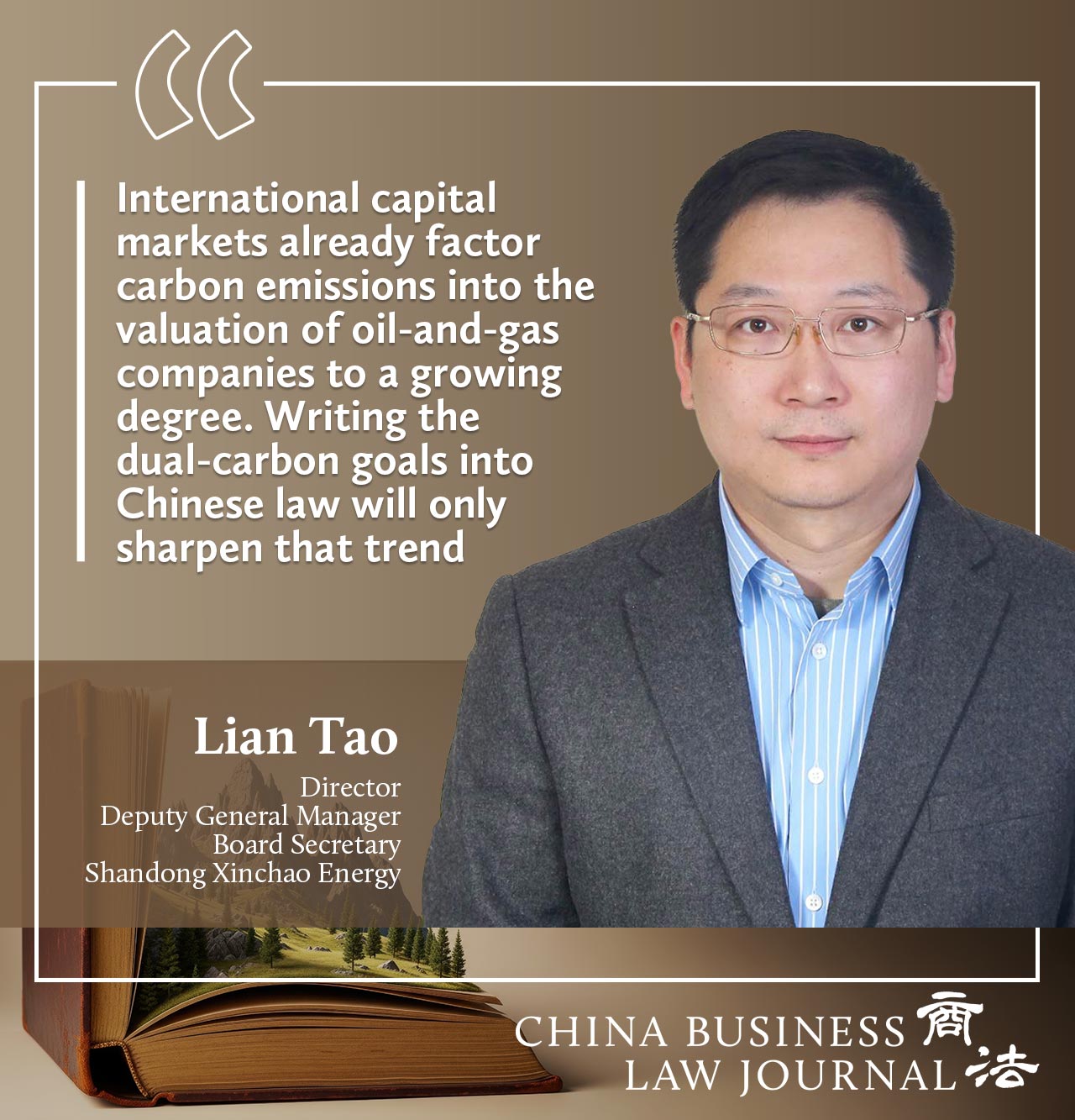
“Domestic investors are likely to pay closer attention to the low-carbon strategy and emissions intensity of our American oilfields,” he says. “International capital markets already factor carbon emissions into the valuation of oil and gas companies to a growing degree. Writing the dual carbon goals into Chinese law will only sharpen that trend.”
WORKING THE WINDOW
With only months to go before China’s first Ecological Environment Code takes effect, in August 2026, corporate legal teams face a stretch of time they may routinely misjudge – long enough for several meetings and a few drafts of paperwork, rarely long enough to overhaul an entire compliance regime.
“The commonest mistake companies make is to wait and see,” says Yu Luping, equity partner at Zhong Lun Law Firm’s Beijing office. Many, he says, talk themselves into the belief that a grace period will follow promulgation, and so cling to the old standards for “products, services and construction projects to which the new ones ought to apply”. Others wait passively for enforcement to bite, “fixating on whether they currently meet the bar while overlooking newer duties such as the recovery of end-of-life products”.
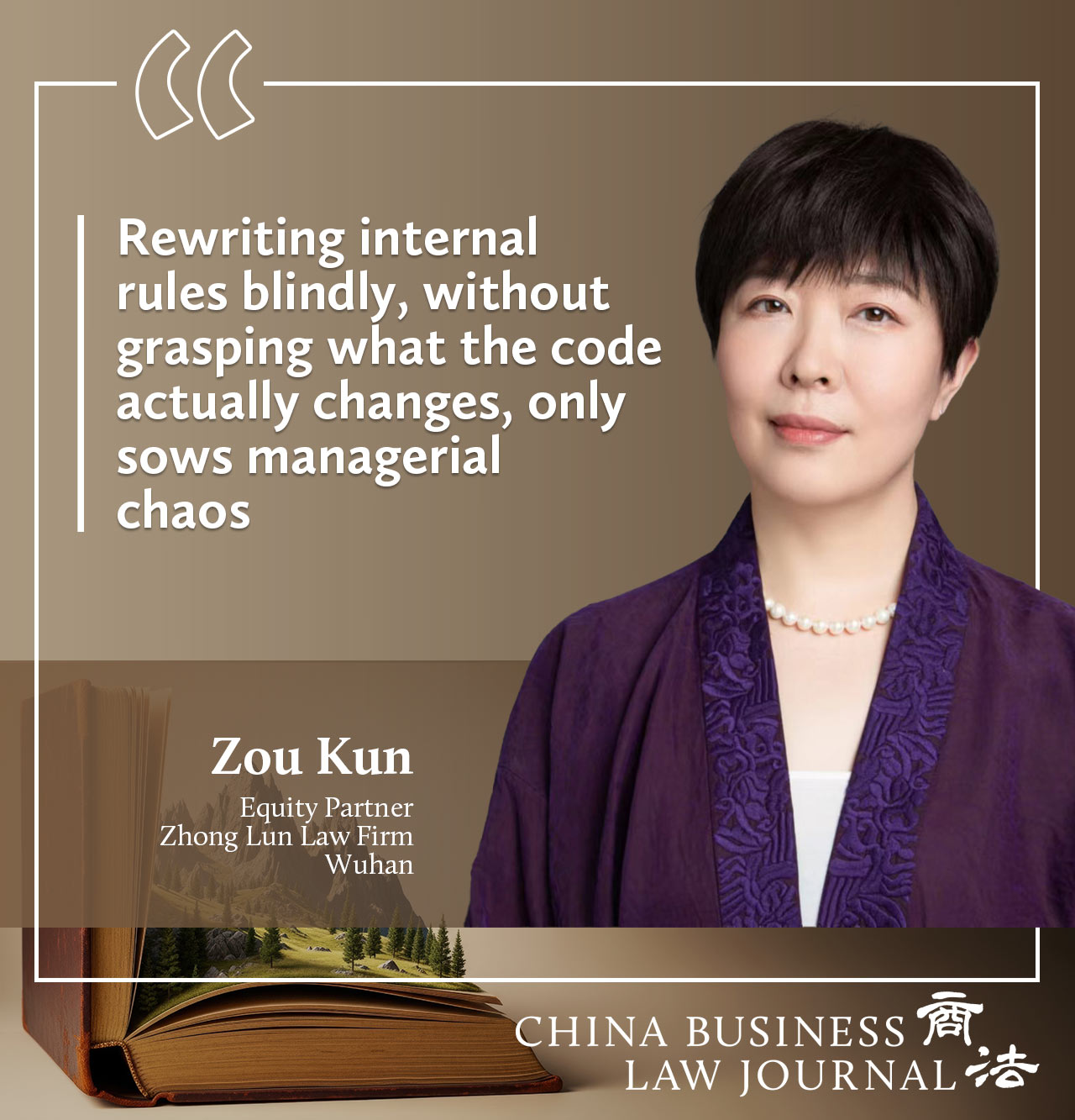
Zou Kun, an equity partner in Zhong Lun’s Wuhan office, identifies the opposite concern: overreaction, or “rewriting internal rules blindly, without grasping what the code actually changes, [which] only sows managerial chaos”.
Whether the problem is hesitation or hyperactivity, the root lies in how the code is understood. Wu Qing, a partner at King & Wood in Guangzhou, sets out three layers of misreading. The shallowest, she says, is to “mistake the code for a tidied up reprint of the old statutes, missing what is genuinely new. Many companies think the code merely bundles the previous single-issue laws together and fail to see the fundamental shift in legislative aim, regulatory logic and the architecture of liability.”
A layer deeper is the habit of “building compliance on paper while neglecting it in practice”. Under the code’s principle of presumed fault, she says “a company that cannot prove its own innocence may be held liable despite an immaculate rulebook, simply because execution was slack and the paper trail incomplete”.
The deepest, and most dangerous, layer is to “underestimate the cost of breach, and trust that a fine will settle the matter”. Wu says companies “tend to count only the administrative penalty, ignoring the far larger sums that ecological damage compensation and civil public interest litigation can extract, and giving little thought to the criminal liability, and lifelong accountability, that grave violations can trigger”.
Chen Guoqiang, senior partner and head of environment and energy at the Hangzhou office of Capital Equity Legal Group, offers a more practical starting point. He urges companies to “audit which of their current activities are still lawful today but will not be once the code takes effect”.
A close reading of the text may also lighten the load on penalties already in train. Under the principle of applying the more lenient of the old and new rules, Chen says “if the penalty decision is issued after 15 August 2026, the fine itself may shrink. In that case, a company is within its rights to seek, through proper channels, a modest delay in the issuance of the decision.”
Drawing on all this advice, in-house legal teams should complete at least five self-audits before the window closes:
-
- Permits. Companies should take stock of three categories – environmental impact approvals, environmental acceptance certificates and pollutant discharge permits. Zou warns particularly against “construction without approval, operation without acceptance, and discharge without licence”, and urges a check on whether capacity expansions or process changes in the past three years have been properly relicensed.
- Operational fidelity. Each process, piece of equipment and discharge outlet listed on the permit should be matched against what stands on site. Zou says undeclared changes on the ground are a common and consequential blind spot.
- Data integrity. Take inventory of monitoring records, says Zou. “Examine the originals from the past year, check that sampling points, indicators and frequencies meet requirements, and that the raw data has been properly filed.” Ledgers for solid and hazardous waste deserve the same treatment.
- Record of stoppages and contingencies. Has every shutdown or overhaul in the past year been reported, with substitute measures taken? Are emergency plans aligned with the relevant national standards?
- Contracts and supply chains. Xu Bin presses for “a self-audit of environmental clauses in contracts and along the supply chain, to head off joint and several liability”. From the M&A angle, Wu says companies must take seriously the code’s principle of inherited environmental liability “and run deep green due diligence before any acquisition”.
Where the weight of each of these five audits falls depends on the industry. For Allen Jiang, general manager of the legal department at Sinochem International, chemicals pushes the review of discharge permits to the front of the queue; building a register of critical certificates and tracking the dates for approval, renewal, amendment and filing is the floor on which everything else rests.
After that sits a thorough mapping of statutory duties and the rewriting of internal rules, done jointly with the safety, health and environment function so that “internal codes mesh cleanly with external requirements”.
Finally, in turn, sits the slower work of pushing the code’s language down to the shop floor. “Routine self-inspection and patching of gaps should take the place of after-the-fact remediation, so that the transition to the code’s regime is a smooth one,” says Jiang.
For Lian Tao, director, deputy general manager and board secretary at Shandong Xinchao Energy, the same logic is on a tighter clock. The three top priorities he has set for his team chime with the lawyers’ counsel: a line-by-line reading of the Ecological and Environmental Code against the company’s existing environmental rulebook, with a list of amendments drawn up wherever the two diverge; targeted training on the code for senior managers and staff in critical posts; and a standing channel of communication with the environmental authorities, so as to keep abreast of regulatory shifts and enforcement priorities.