












China’s capital market players brace themselves for a new era characterised by tight regulation, a slowdown of new listings, and renewed interest in key international destinations. Sophia Luo reports
This April, the issuance of Several Opinions of the State Council on Strengthening Regulation, Preventing Risks and Promoting the High-Quality Development of the Capital Market, commonly referred to as the third set of the National Nine Articles, became the talk of the town.
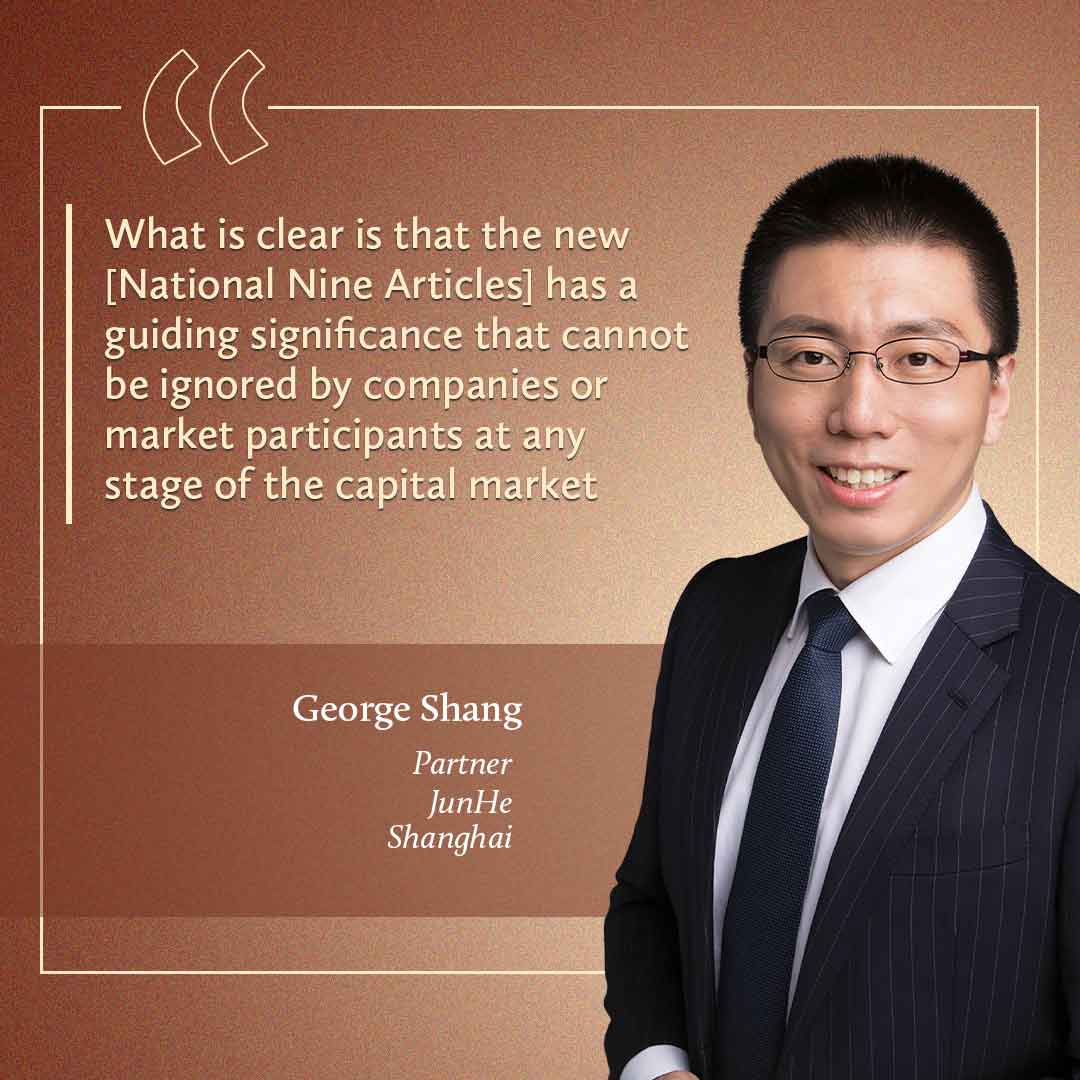
George Shang, a Shanghai-based partner at JunHe, says this framework document set to guide the development of the domestic capital market in the near future encompasses measures ranging from stricter entry rules for listings to strengthening compliance and delisting supervision.
Overall, the new National Nine Articles put forward higher listing standards (including indicators like the optimisation and improvement of corporate revenue and net profit), higher quality requirements for listing counselling, improved compliance in the listing environment (including a severe crackdown on financial fraud and illegal reduction in shareholdings), and normalised delisting and trading supervision.
“What is clear is that the new regulation has a guiding significance that cannot be ignored by companies or market participants at any stage of the capital market,” says Shang. “Also worth noting are the long line of refined rules and regulations that are sure to follow.”
In view of the many highlights in the new regulations, Zhai Xiaojin, a partner at Tian Yuan Law Firm in Shanghai, advises listed companies to pay close attention to a ramping up in regulatory efforts on dividends.
Zhai explains that in the past, the distribution of dividends was generally believed to fall into the scope of autonomous business operation, and regulators mostly paid little attention to it unless there was a clear violation of regulations and commitments. “But since the new rules, dividend distribution that fails to meet the standard or exceed the level of business performance will become the focus of supervision for some time to come,” says Zhai.
Financial fraud, embezzlement of funds and illegal guarantees have long been the three red lines of corporate audit and supervision in practice. In view of this, the new regulations focus on the rectification of financial fraud and embezzlement – two types of illegal acts that most severely affect listed companies and are deemed the most egregious conduct. Zhai believes that companies should closely watch these aspects.
In view of the strengthened and continuous supervision on listed companies demonstrated by the new National Nine Articles, Leo Lou, a partner at Fangda Partners based in Shanghai and Guangzhou, suggests that companies and shareholders should abandon the outdated idea that going public equals “all good”. Furthermore, since the new regulations also highlight the responsibility of intermediaries as gatekeepers, such pressure will eventually be transmitted to companies, and Lou expects that in the future fewer intermediaries would be willing to extend their services to flawed companies.
Quality over quantity
Following the introduction of the new National Nine Articles, various supporting reform initiatives for the capital market are being pushed forward with steady progress, quickly forming the “1+N” policy system. The IPO downturn, both in terms of the number of deals and proceeds, also resonates with the strict control over A-share listings outlined in the new National Nine Articles.
As of mid-June, as many as 44 A-share companies had been listed on the Shanghai and Shenzhen stock exchanges this year, raising a total of RMB32.9 billion (USD4.5 billion), with the number of IPOs and the amount of capital raised down 75% and 84% year on year, respectively.
In fact, since the China Securities Regulatory Commission (CSRC) announced a series of measures on 27 August 2023, indicating a “temporary tightening of IPO pace”, the number of companies waiting in line to go public had declined from more than 700 at that time to currently 500 or so. Many firms queuing for listing have now terminated their listing plans, and a sharp drop had also been recorded in the number of new IPO filings.
Zhai believes that companies rushing to withdraw their market listing applications does “reflect that some would-be listed firms, especially those with remarkable cyclical characteristics, have suffered a significant decline in performance, and their phase-based financial indicators do not meet the listing requirements”. She also notes that some companies were asked to withdraw by regulatory authorities after on-site inspection due to not having clear positioning in their sectors, or flaws in the filing materials.
From the perspective of market inventory, there are currently more than 5,000 companies listed in the A-share market, roughly the same number as that in the US. However, the total market value of A-share listed companies is less than half that of their US counterparts. Pan Xinggao, a Beijing-based partner at Commerce & Finance Law Offices, says that “such a large inventory of listed companies can sufficiently meet the need of Chinese economic development and market financing”.
In view of this, Tang Zhoujun, a Beijing-based equity partner at Zhong Lun Law Firm, notes that businesses of listed companies, especially those making their IPOs, should be closely related to industries that cultivate new productive forces, support national strategic development, and uphold national stability and people’s wellbeing. “Hence, there may be a massive number of IPOs in the A-share market in the short term,” says Tang.
According to Jing Chen, a partner at Slaughter and May’s Beijing office, 69% of A-share IPOs in the first half of 2024 were in strategically important sectors such as industrial, information technology, media and telecoms. “TMT (technology, media and telecoms) and industrial companies will be the key drivers of China’s IPO market in 2024, despite the tightening regulatory environment,” says Chen.
There is a consensus among many interviewed partners from domestic and international law firms that “tough entry, smooth exit, and survival of the fittest” is the consistent thread running through all these policies that A-share listed companies must follow for some time, and that the slowdown of new listings is a product of policy directions. This is a trend that won’t be reversed in the short run, they believe.
With an increasing number of companies screened out of the IPO vetting process, Li Liujie, a partner at Jingtian & Gongcheng based in Shenzhen and Beijing, expects the wave of application withdrawals to continue for some time. There may also be greater investor demand for new listings given the scarcity of high-quality IPOs. “This may lead to stronger post-IPO performance, but it will also add to volatility of the market,” says Li.
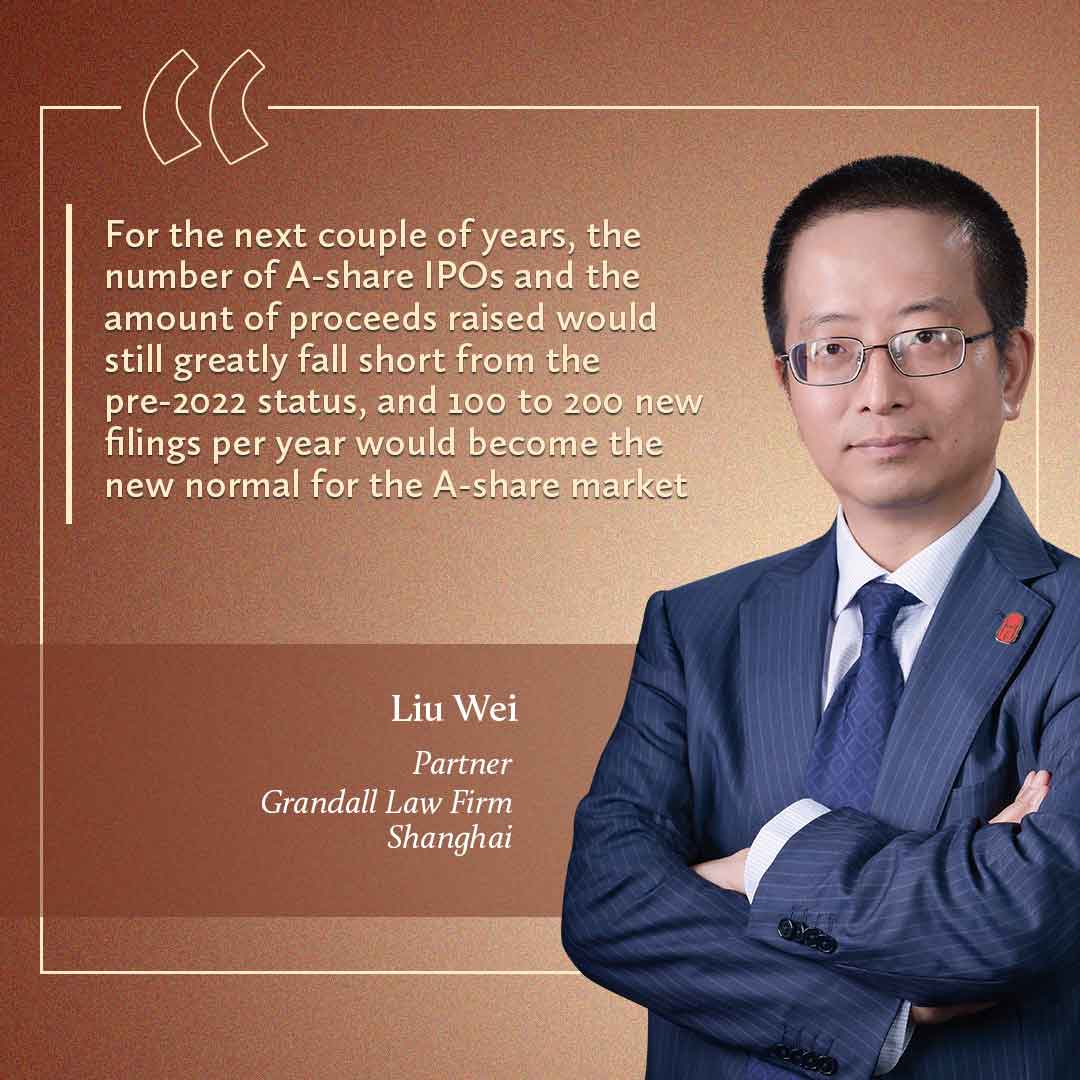
Despite the regulatory momentum, Liu Wei, a Shanghai-based partner at Grandall Law Firm, glimpses a positive signal. Before 20 June, only two new A-share listing filings had been accepted this year, both for the BSE, and zero from the Shanghai and Shenzhen bourses. Since then the stalemate has been broken, he says. Two more A-share IPO applications have been accepted, for the Star Market of the Shanghai Stock Exchange and the main board of the Shenzhen Stock Exchange. Both filings are handled by Grandall.
Liu believes such a breakthrough indicates a gradual return to normal IPO acceptance and vetting. But he emphasises that, due to the raising of the listing bar, reforms of the issuance pricing mechanism and the impact of economic complications, “for the next couple of years, the number of A-share IPOs and the amount of proceeds raised would still greatly fall short from the pre-2022 status, and 100 to 200 new filings per year would become the new normal for the A-share market”.
Pan, at Commerce & Finance, has shifted his focus on how to integrate and optimise the existing market resources. He suggests IPO candidates that fail to meet the listing conditions due to a tighter regulatory grip, but that possess business assets of good quality, could consider M&A to digest some of the inventories.
From the perspective of companies tagged “ST” (special treatment), a way to flag A-share companies for delisting or other risks, and their controlling shareholders, Pan suggests they fully assess the pros and cons of both staying listed and delisting, considering factors such as cost, success rate and investor lawsuits.
Investors, on the other hand, should focus on how to protect their interests and investment losses in the case of delisting, and clarification is needed on how to define the cause-and-effect relationship between “investments are subject to risks” and securities litigation liability.
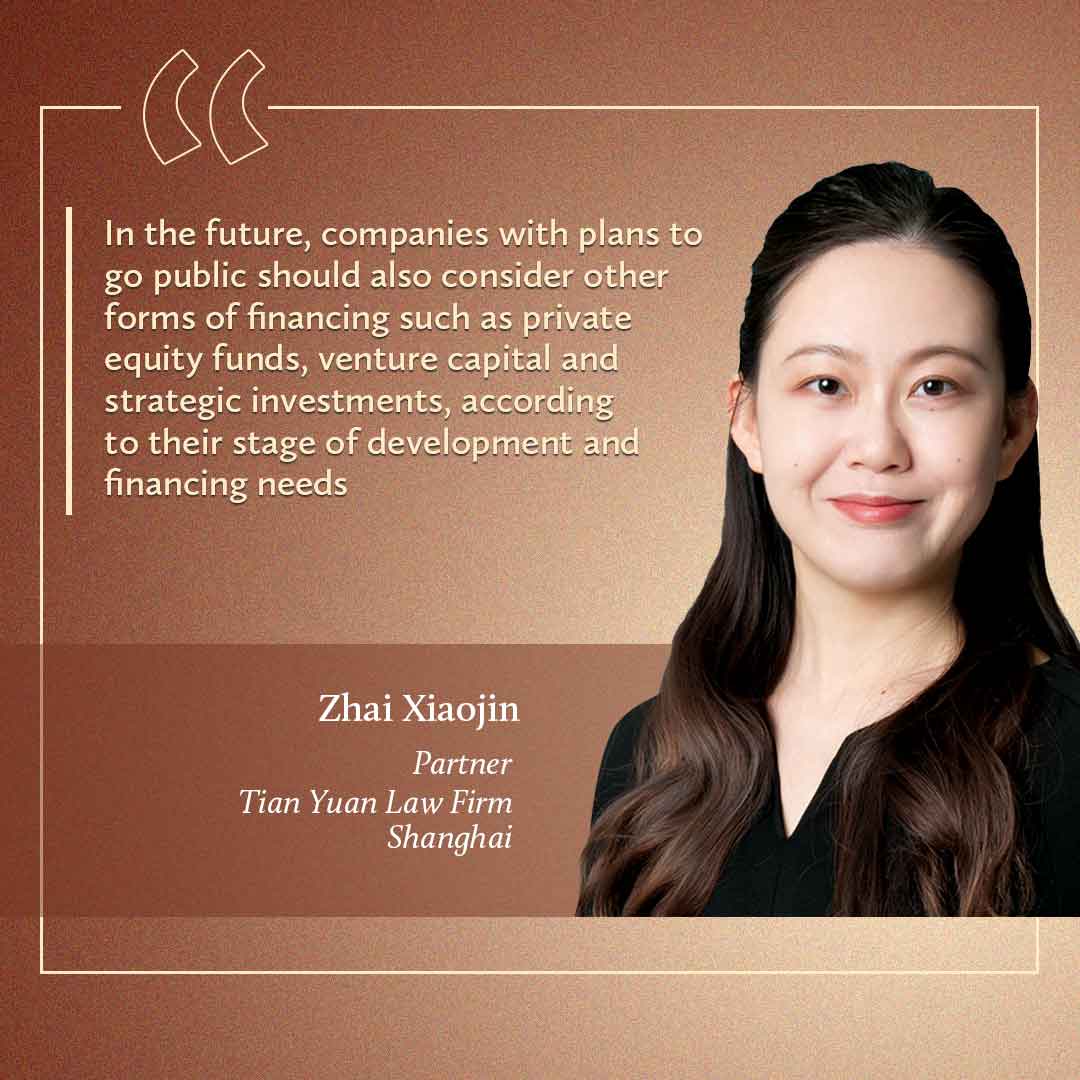
Zhai at Tian Yuan sees opportunities in the incremental market. “In the future, companies with plans to go public should also consider other forms of financing such as private equity funds, venture capital and strategic investments, according to their stage of development and financing needs,” she says. “They can also make use of the multi-layered capital markets, trying out the diversified financing channels such as the BSE, the National Equities Exchange and Quotations (NEEQ), and regional equity markets.”
Crossing borders
With the A-share market raising the bar for new listings, more Chinese companies are looking elsewhere. Zhang Jie, a Hong Kong-based partner at Cooley, says that in the year to date she has seen a growing number of enquiries from companies originally planning to list on the mainland, but now considering Hong Kong or overseas.
Since the Trial Measures for the Administration of Overseas Issuance and Listing of Securities by Domestic Enterprises took effect in March 2023, as of mid-June this year the CSRC has cleared a total of 148 companies for international listing. Seventy-six have been granted a go-ahead so far this year, with 33 to Hong Kong and 43 to the US. Seventy-two had been approved in 2023, comprising 46 to Hong Kong and 26 to the US. Meanwhile, 104 international IPO filings are in the pipeline, involving 78 for Hong Kong, 25 for the US and one for Switzerland.
In light of this data, Lou at Fangda concludes: “Registration with the CSRC has become a regular practice for domestic companies eyeing international listings.” The number of firms cleared by the CSRC in the first half of this year has exceeded the total number last year, painting a convincing picture of the growing enthusiasm of domestic companies to pursue IPOs elsewhere. In terms of IPO destinations, Hong Kong and the US remain the go-to options, with Hong Kong attracting the most issuers, and a few heading to Switzerland.
You must be a
subscribersubscribersubscribersubscriber
to read this content, please
subscribesubscribesubscribesubscribe
today.
For group subscribers, please click here to access.
Interested in group subscription? Please contact us.
你需要登录去解锁本文内容。欢迎注册账号。如果想阅读月刊所有文章,欢迎成为我们的订阅会员成为我们的订阅会员。