











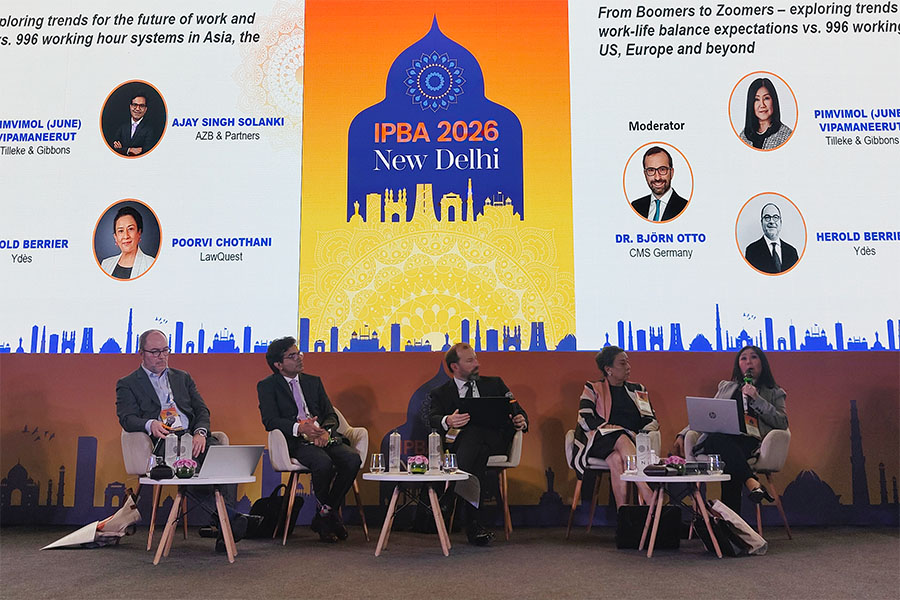
One of the sessions at the Inter-Pacific Bar Association (IPBA) on 26 February was titled “From Boomers to Zoomers – Exploring Trends for the Future of Work and Work-life Balance Expectations v 996 Working Hour Systems in Asia, the US, Europe and Beyond”.
Moderated by Björn Otto, a partner at CMS Germany in Cologne, the speakers represented diverse geographic backgrounds. Ajay Solanki, partner at AZB & Partners in Mumbai; Harold Berrier, partner at Ydès in Paris; Poorvi Chothani, managing partner at LawQuest in New York; and Pimvimol (June) Vipamaneerut, partner at Tilleke & Gibbins in Bangkok.
The discussion compared work cultures across regions, highlighting differences in flexibility and regulations.
Chothani described the US system as “extremely flexible” compared with the more structured European system, but noted that refusing to work long hours in the US could result in dismissal. The conversation then turned to lawyers’ own working hours.
Berrier said: “French lawyers are not subject to working hour regulations. However, if you employ lawyers, you’re supposed to comply with regulations.”
Otto shared an anecdote about a former associate at an investment bank in New York who sued her workplace. “It was contractually agreed that she needs nine consecutive hours of sleep every night. In return, she would work seven days a week. During a deal, at 1am, she left and said she [needed] to go to bed. As a result, they fired her.”
Chothani said the former associate should win the case because, in the US, the contract prevails.
Otto told India Business Law Journal, “While older employees tend to be more accepting of traditional work structures and working time rosters, younger generations oftentimes do not only expect fewer hours, but above all more autonomy.”
Vipamaneerut said associates in Thailand work long hours because they want to be promoted. “We allow them to work longer hours, and the next day, if you come in late, we don’t mind at all. We are entitled to overtime, but my associates and I never claim it. If they work overtime or on Sunday, then I reward them with a bonus.”
She added that, as a partner, she did not have the authority to hire or fire a lawyer. But she can make a proposal to the management committee about it.
The concept of a four-day work week was also debated, with Solanki discussing its applicability in India under the recently introduced labour codes. The speakers expressed differing views on its practicality and impact on productivity and work-life balance.
At the other extreme is the 996 work culture. The term 996 refers to a 12-hour-a-day, six-day-a-week schedule that emerged in China’s tech industry.
“From a legal perspective, 996 is not legally enforceable in many jurisdictions worldwide,” said Otto, noting the statutory overtime caps in Thailand and the binding rest requirements in Europe. He concluded: “More hours mean poorer results.”