



Bridget McCormack, president and CEO of American Arbitration Association-International Centre for Dispute Resolution, tells Manokamana how she is keeping her institution up to date in the AI era
Arbitration is one of the most popular alternate dispute resolution (ADR) methods, especially for commercial disputes. The method has multiple dedicated international centres, with regular promotions and awareness drives, inviting parties to settle their disputes the best possible way, through arbitration.
The American Arbitration Association (AAA) is the largest and most prominent arbitration institution in the US, turning 100 this year, and its global research and education initiative is nearly as old.
Bridget McCormack, president and CEO at AAA-International Centre for Dispute Resolution (ICDR) shares that the institution’s long history was one of the things that attracted her to the role.
“It [AAA] has a pretty important standing in the legal community in the US,” says McCormack, who was previously chief justice of the Michigan Supreme Court. “The fact that the AAA was a non-profit and could really think about what’s best [for the profession] instead of profits [was appealing].”
This, however, does not discount the presence and significance of other US-based arbitration-focused organisations for McCormack. AAA simply suited her objectives.
“[Other organisations] have a big presence in the US, but they have owners, and the owners want their profits at the end of the year. It just doesn’t motivate me as much as the mission focus of figuring out how to get more ADR to more people.”
The drive to reach as many people as possible has seen AAA institutions open outside the US. The organisation’s ICDR is an international cross-border arbitration centre active in multiple jurisdictions across the world, focusing on region-specific arbitration needs.
It was at the ICDR India Conference 2026 in New Delhi that India Business Law Journal caught up with McCormack to discuss her journey and views on arbitration.
AAA’s AI journey begins
McCormack says that expanding AAA’s reach has evolved to mean the rapid inclusion, adoption and acceptance of modern technology into operations: internally, for its own functioning; and externally, for the services it offers, at the centre of which is artificial intelligence (AI).
Acknowledging the need for careful and responsible use of AI, McCormack says the AAA has an enterprise ChatGPT account to ensure privacy and security while using AI. “The enterprise licence is a big deal because it gives us a safe environment to be able to play in,” she says. “[AI] operates across all of our internal documents, so it’s extremely helpful. Everybody has to have generative AI training. Everybody has generative AI goals. We have guidelines for our staff to follow. There are things they’re allowed to do and things they are not allowed to do.”
McCormack mentions the use of “lots of really effective chat bots, some internal and some external” and gives the organisation’s HR department as an example. “Most people just interact with the HR chatbots … and if something gets complicated, they can go to the HR humans that are working in the HR [department],” she says.
She credits their creation of AI tools to the already widespread use of AI by teams at the organisation. “All ideas come from our teams from across the AAA. And the only way you get good ideas from people is if they’re using it all the time,” McCormack says.
The AAA also has a chatbot that can help clients in whatever language they prefer to use. “People who are trying to navigate our processes, especially people who can’t afford lawyers – which is a lot [of people] – they now have a natural language helper,” she says, adding that the chatbot has already been trained on AAA rulings, rules and cases.
Another AI tool is the AI Arbitrator, McCormack’s brainchild. This tool speeds up the dispute resolution process. It works on claim parsing, document summarisation and analysis, while the final award is issued by a human arbitrator, ensuring accountability. The AI Arbitrator is still in development, though, and for now is only available for two-party, document-only construction cases.
Building the AI Arbitrator
Asked why the AI Arbitrator is only used for disputes in the construction industry right now, the answer is fairly straightforward: “We just have so many construction cases. It’s a huge docket for us, and we have a really close relationship with the arbitrators in the industry, because we have so many cases.”
She says another reason why the construction industry was a first focus of this AI tool is the longstanding experience of the organisation with construction sector disputes, which has given it a good understanding of the industry’s nuances and a lot of material for the AI Arbitrator to train on.
“In ongoing construction projects, one dispute can stop the project,” says McCormack, “so they really need some mechanism for the disputes that come up along the way, to get those decided – and quickly too.”
The model is being trained on awards that are in the AAA’s system and she credits the longstanding relationship between the AAA and professionals in the construction disputes industry for the fast progress with the AI tool.
“It was a lot smoother to build,” she says. “We had a group of arbitrators and advocates who were in our sprints. We built it over about 10 months, and every two weeks we had a new sprint.”
Practising professionals were not the only ones involved either. A law professor well versed in the use of technology and AI for judicial purposes was part of the process.
“We invited a law professor under the tent as we built it [the AI Arbitrator], who we didn’t have any relationship with,” says McCormack. “He’s done work on judicial decision making with AI, and he has a technology background, so he’s qualified. We let him evaluate it and kick the tyres, and he’s written a white paper, which we will release eventually.”
Transparency, security matters
The building of the AI Arbitrator also included the preparation and implementation of security policies. “When parties use what we’ve built, it is only operated on our system. It’s not in the cloud, it’s on the premises, and then we don’t retain [the data],” she says.
“I think trust is what you hopefully earn by building transparently. So we’re showing everybody what we’re doing. [There are] videos and other [content] on our website, so that people understand what we’re doing and how we’re doing it.”
In addition to self-produced and published content, the AI Arbitrator’s functioning will be audited. “We have an organised set of audits that we do on what we’ve built, and we’re going to make these results public so that everybody can actually see how [the AI Arbitrator] is performing,” she says.
The audit will include the tool’s progress, performance, the presence of any bias and the associated details, if any.
For ongoing governance of the AI Arbitrator, McCormack says a committee was formed consisting of lawyers, the AAA’s in-house counsel and team, and its chief information officer and team.
“They’re not only active in evaluating the work that the arbitrator does there, they evaluate any partnership we take on with any other company that builds with AI,” she says. “Because it’s not enough to be confident about your own internal builds; you have to be confident about anybody you’re actually working with.”
McCormack points to a page dedicated to governance principles on the AAA’s website, and says this is something that is not taken lightly by the organisation, which is “spending a lot of time on this lately, because nobody else seems to be thinking about it yet in a sophisticated way”.
Journey to arbitration
McCormack’s career has given her ample experience for her present role. She graduated from New York University School of Law, then went into litigation. From there she joined the faculty, first at Yale Law School, then at the University of Michigan Law School. From there, she was elected to the Michigan Supreme Court and later became its chief justice – a role she held until joining the AAA.
She says her interest in arbitration is rooted in her observations of the judicial process over the years of her professional journey. “Courts across the US view ADR as pretty important to what they do, because they couldn’t possibly resolve all cases in court. We really need ADR mechanisms to be able to support this ecosystem of dispute resolution.”
However, McCormack also acknowledges that arbitration in itself is not a faultless method of dispute resolution.
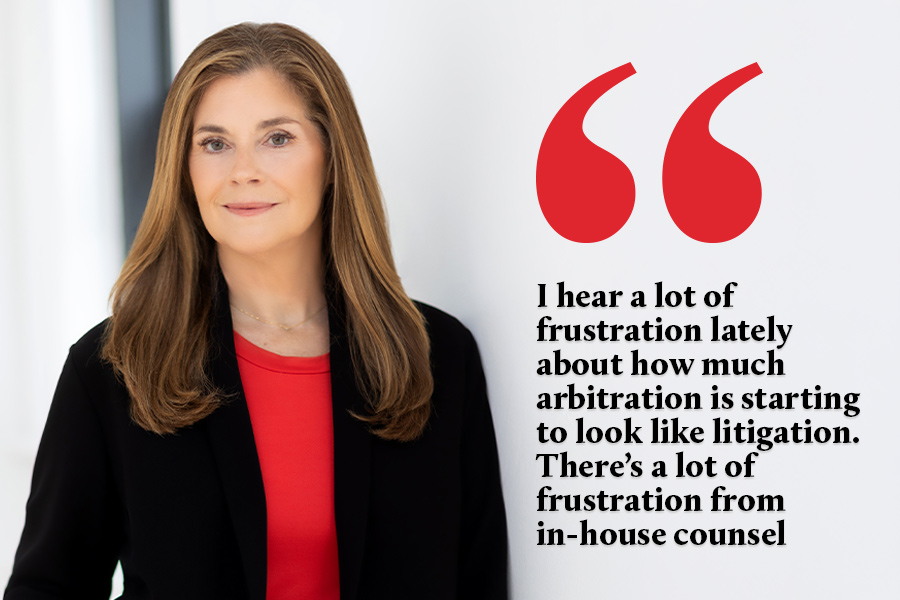
“I hear a lot of frustration lately about how much arbitration is starting to look like litigation. There’s a lot of frustration from in-house counsel,” she says.
A major part of litigation not being the preferred method of dispute resolution is due to the time and cost it may sometimes require. McCormack has observed that outside counsel are not bothered by this, as they bill by the hour. But this situation has turned in-house counsel into less enthusiastic believers in arbitration.
However, she still believes arbitration remains the most viable form of ADR for commercial disputes. “There are benefits in a cross-border dispute, even if it takes longer and costs more. Parties [usually] don’t want to litigate. So cross-border disputes have another important reason to be there.
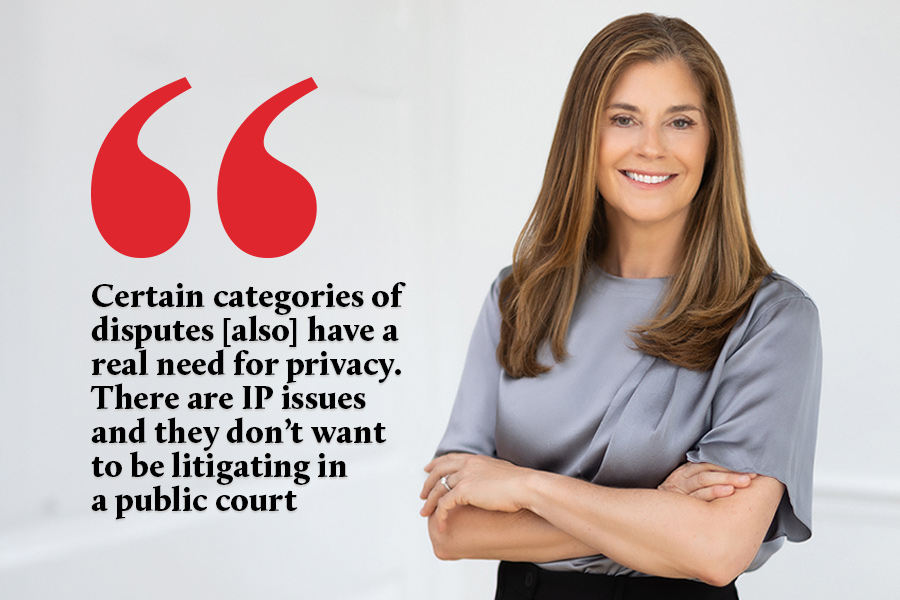
“Certain categories of disputes [also] have a real need for privacy. There are IP issues and they don’t want to be litigating in a public court.”
Coming up next
There is no doubt in McCormack’s mind that technology will be the strongest driving factor of change in the future. “Technology is moving a lot faster than humans are in terms of change management right now, and it’s going to allow some exciting advances in dispute resolution,” she says.
On the role of AI, she says: “Imagine if a contract is negotiated and executed on blockchain – you could build in monitoring agents that spot a dispute before it’s ripe. They spot a supplier delivery that’s late and before it festers and becomes [an issue], they can actually get it resolved.”
McCormack says the AAA will expand the AI models they use in the near future: “We’re now getting an enterprise Anthropic account as well, and we want to improve on our models to be able to call them a frontier model.”
As for her AI Arbitrator tool, McCormack says that more sectors will slowly be added to its purview. The next in line is aviation and some documents-only commercial disputes.
Beyond that, the AAA already has a list of industries it plans on including as focus areas for the AI Arbitrator and hopes to roll them out as soon as they are safely ready to be presented to clients.