








The five most common practice areas of these new hires and their proportion are:
Dispute resolution (29.4%)
Capital markets (22.1%)
Corporate and M&A (17.6%)
PE/VC (13.2%)
IP (13.2%)
Revenue of 111 Chinese law firms depicts a struggling legal market and a rampant race for survival. Kevin Cheng reports
Hysteresis is a quality often attributed to the legal services market. In China, as businesses strive to shake off the worst economic rut of recent memory – from the real estate woes to stagnation in the capital markets – and focus on opportunities in overseas markets and emerging sectors, law firms by and large are still bearing the brunt of the austerity.
The “wait and see” approach is no longer looking like a viable option, China’s growing pool of domestic law firms find themselves pivoting every other way in a fierce bid for survival. Some divert resources and manpower to the few practice areas and sectors on the rise, some take the opportunity to aggressively increase their scale of operations and market presence, some reluctantly take on tasks they used to deem “too marginalised”, and then some resort to lowering their fees while offering added value.
Meanwhile, their competitors are doing the same thing.
Conundrum in the middle
Around 130 Chinese law firms participated in China Business Law Journal’s most recent annual market survey, among which 111 shared with us their revenue in both 2023 and 2024, forming the backbone of our research.
The median revenue of these 111 firms arrived at RMB133.2 million (USD18.5 million) in 2024, a 16% drop from RMB158.6 million in 2023. The highest earner in 2024 raked in an impressive RMB10.2 billion.
This number suggests that the nosedive in the industry’s general profitability since 2022 had continued well into 2024, not to mention a far cry from the median peak of 2019 at RMB250 million, or the resurgence of 2021 at RMB223 million, as recorded in our past annual market research.
However, not all statistics spell doom and gloom. The same pool of law firms secured an average revenue of RMB516.1 million in 2024, a 3.8% increase from 2023’s RMB497 million. In fact, on taking a closer look at the data, about 65.8% of the law firms, a clear majority, saw their 2024 revenue grow compared with the previous year, while 34.2% recorded a downturn or remained constant.
It should be noted that market-leading firms generally posed less than stellar results, with the revenue of all “red circle” firms that shared data with China Business Law Journal dropping within a range of 4% and 10%.
The eight law firms that achieved revenue of more than RMB1.5 billion in both years – the cream of the crop – tell a mixed story in terms of slowing growth, decreasing by an average of -0.7%. In comparison, law firms with revenue between RMB1 billion and RMB1.5 billion secured an impressive average growth rate of 14.1%.
In 2024, 16.2% of law firms saw their revenue exceed RMB1 billion, up from 12.6% in 2023.
When considering the number of lawyers, the average revenue per lawyer (RPL) in 2024 arrived at approximately RMB962,000, with the median at around RMB633,000. Among law firms with at least 10 lawyers in the lineup, the highest RPL was RMB4.5 million.
A shift in balance
Tang Zhoujun, a Beijing-based equity partner at Zhong Lun Law Firm, defines this period as one of profound change for the legal market, which is now facing a series of tricky external challenges.
“These are arduous tests, but also opportunities for us to transform and upgrade,” he says. “The requirements for law firms’ business, service and management capabilities have grown to almost unprecedented levels.
Economic downturn, foreign capital withdrawal, trade war … there is no end to the reasons for law firm’s struggles, but the most direct attribute may be no further than the status of their paying clients.

“The legal industry is caught in the slowdown of economic growth,” says Kevin Huang, a Shanghai-based partner at Commerce & Finance Law Offices. “With reduced payment capacity for legal services, clients are being extra careful about handling legal affairs.”
Transactional lawyers have a particularly rough time, with traditional pillar practices such as capital markets and M&A taking a turn for the worse in 2024. China’s A-share stock exchanges saw only 100 completed IPOs in 2024, a devastating drop compared with 313 in the previous year; even the Hong Kong Stock Exchange hit a decade low with 67 IPOs.
Moreover, PWC’s report indicates that the transaction value of China’s M&A market in 2024 declined by 16% compared with 2023, although the transaction volume went up by 24%. Such depreciation in value per case is a phenomenon that many lawyers can relate to.
Zhu Zhongjie, a Guangzhou-based partner at Kingbridge Law Firm, observes a migration of transactional lawyers to busier areas such as dispute resolution. “Clients’ needs [for dispute resolution] have been growing – as has the case volume – but overall their paying capacity has been quite affected,” he says, admitting that adding the headcount of dispute lawyers could be a positive factor for the law firm’s revenue, but the legal fees per case have markedly gone down compared with two years ago.
Sam Wei, founder and director at Ricc & Co, based in Shanghai, echoes the sentiment. “The total number of cases continues to grow, but not as fast as the number of practising lawyers, which causes a lot of stress on the per capita revenue,” he says.
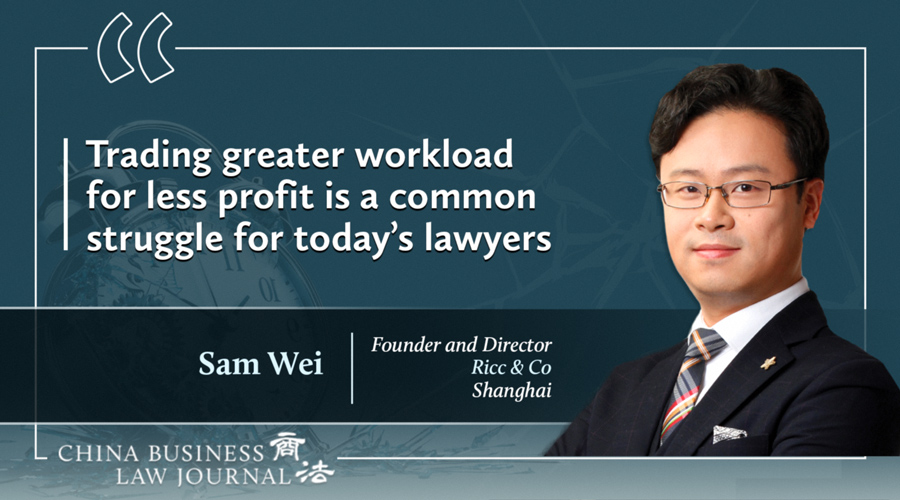
“Trading greater workload for less profit is a common struggle for today’s lawyers,” he concludes.
Near the end of 2021, China’s Ministry of Justice (MoJ) issued the National Public Legal Service System Development Plan (2021-2025), which said, under the chapter of General Requirements: “By 2025, the number of practising lawyers in China shall reach 750,000.”
Has this goal been attained now that we have passed the middle point of 2025? No official word from the MoJ has confirmed this either way. However, the China Statistical Yearbook, compiled by the National Bureau of Statistics of China, offers some insight. According to the 2024 edition, the total number of lawyers in China exceeded 730,000 as at the end of 2023; and for the prior five years, this number grew at a compound annual growth rate (CAGR) of 11.5%.
When the number of market players grows faster than said market, measures that may be traditionally considered “drastic” or even “questionable” begin to look appealing, including but not limited to price war, discounts, striking deals with legal consultancies, and mass online promotions targeting lower-tier markets. “Quotation for perennial legal services could in some cases go as low as RMB15,000,” a partner in Beijing told China Business Law Journal.
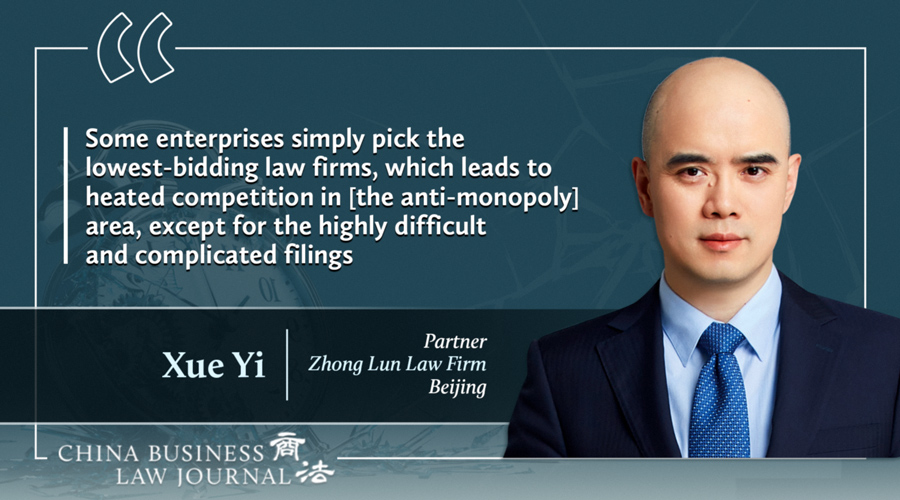
Xue Yi, a partner at the Beijing head office of Zhong Lun specialising in anti-monopoly practices, observes that many companies underestimate the importance of quality and the expertise required for merger filing, leaving room for low-price competition in this area. “Some enterprises simply pick the lowest-bidding law firms, which leads to heated competition in this area, except for the highly difficult and complicated filings,” he says.
Xue sees an upward trajectory of business opportunities in the first half of 2025, but also greater competition, especially with more regional and boutique law firms tapping into the area.
Confronted with the decline in the cost-to-benefit ratio of conventional legal services, law firms hold differentiated and specialised services to be the path forward. “In a highly competitive market with mounting external pressures, greater professional specialisation is inevitable,” says Zhu Zhiwei, a Shenzhen-based partner at King & Win Law Firm. “This, in turn, demands close collaboration to break through the resulting complexities.
“Lawyers and law firms should focus on working with one another,” he says. “Cease this meaningless rat race and improper competition, and create a rewarding environment for legal services.”

Undoubtedly, this raises the bar for lawyers’ required knowledge and level of expertise to stand out. Liu Sen, senior partner and executive deputy director at the Beijing office of DHH Law Firm, observes a greater amount of complex cases in the market, demanding lawyers to be simultaneously an expert at the Company Law, the Securities Law, dispute resolution, civil-criminal crossovers, administrative penalties, contractual fraud, and more.
“After many years of development, the market has come to a breaking point,” he says, “which demands a lot more from lawyers in their technical know-how and general capabilities.”
Ma Lihong, a fellow executive deputy director at DHH, worries for the nascent young lawyers without the benefit of years of resource accumulation. “The margin for error in lawyering is getting lower, which is a primary source of young lawyers’ stress,” she says.
International law firms, while positioned to cater to the top clients and deals in the market, are not immune from the challenges of having fewer paying clients, lower-paying clients, and competition from domestic law firms.
“For the state-owned enterprises [SOEs], they have strict internal protocols, so payment of legal fees has been stable and in line with our expectations,” says Ray Liu, a global partner and head of the Beijing office of Dorsey.
“For private enterprises, on the other hand, much depends on the exact industry,” he says. “Many sectors are suffering from a downturn in the economic cycle, forcing them to adjust the fee-payment ratio and target amounts.”
Alternative fee arrangements such as discounts to hourly rates or contingency fees, are sometimes made to make deals happen.
“For instance, a lengthy project is sometimes divided into multiple sub-projects, each with its own separate quotation,” says Liu. “Companies would on occasion require international firms to provide fee caps on specific sub-projects.”
Although not unsympathetic to clients’ needs to play it safe, Horace Lam, a co-head of Asia IP and co-country managing partner based in the Beijing office of DLA Piper, cautions against excessive concessions.
“Honestly, most companies are making less money than they were,” he says. “Clients are asking for discounts, and it is not uncommon to give discounts. But we need to do it sensibly and make sure that the profitability is still there.”
Upsizing a priority
For many law firms in China, upping the scale in terms of lawyer headcount and number of offices is not a spur-of-the-moment reaction to the challenging business environment, but a strategic objective on the very top of the agenda.

Lantai Partners is one of the law firms eagerly exercising the upscaling strategy. According to Yang Guang, founding partner based in the Beijing head office, this path is most directly determined by its practice areas and clients’ industries, as well as a part of the natural development patterns. Although, the impact of external factors like market competition and clients’ preferences should not be downplayed.
“When the market shrinks, the urgency of scaling up becomes significantly magnified,” he says.
He points out that a sufficiently sizeable law firm could provide one-stop solutions catering to institutional clients and complex demands by leveraging its national or even global network. The strategy also helps the firm optimise its rates to gain an edge in cost-effectiveness, as well as improve its brand credibility and risk resilience.
“More than anything else, size, service quality, delivery efficiency and rates are key factors that institutional clients – or even high-end individual clients – consider when choosing a law firm,” he sums up.
Based on the statistics of approximately 50 law firms that provided us with detailed personnel data, Chinese law firms’ number of equity partners grew by 13.7% on average from 2023 to 2024, while the total number of lawyers grew by 4% on average.
In 2024, 76.2% of these law firms registered growth in equity partner headcount, while 61.9% saw growth in their total lawyer numbers. In terms of gender, male equity partners outnumber their female counterparts by approximately 9:5; however, when it comes to all lawyers, the number of female lawyers edge out male lawyers by roughly 10:9. On average, law firms promoted 10 partners and hired 6.2 partners.
Between 1 July 2024 and 30 June 2025, China Business Law Journal reported 136 instances of notable partners being hired in China or by Chinese law firms.
Notably, 8.8% of these hirings concern partners with expertise in construction and engineering, a clear standout among industry sectors.
The vast majority of these partners join the Hong Kong (28.7%), Beijing (25%), Shanghai (23.5%) or Shenzhen (11.8%) offices.
Furthermore, we also reported the opening of 42 new law firm offices in China or by Chinese law firms elsewhere. The most popular regions in China for new presences are Jiangsu (25.9%), Guangdong (22.2%), Southwest China (14.8%) and Northwest China (11.1%).
Searching for breakthrough
Like most other tertiary sectors, legal services tend to follow the trail of business. With the fervor of outbound investment spreading among Chinese companies, it is little wonder that law firms are also eagerly exploring opportunities beyond the horizon.
Based on research conducted by China Business Law Journal, the most common overseas jurisdictions in which Chinese outbound businesses require local legal services over the past two years, as well as their percentages, are: Hong Kong (3.9%), Japan (3.7%), Singapore (3.5%), the US (3.2%) and the UK (3.2%).
In grander geographical terms, the five most popular destinations for Chinese outbound businesses are: Southeast Asia (16.6%), Western Europe (12.2%), Africa (12.2%), Latin America & the Caribbean (9%), and Greater China that excludes the mainland (7.9%).
In terms of overseas destinations of new offices, Southeast Asia (42.9%) emerges as a favourite among Chinese law firms, with new sites sprouting across Singapore, Malaysia, Thailand, Myanmar and Indonesia. This is followed by Hong Kong (28.6%), which has also seen a surge in the presence of mainland Chinese law firms in the form of both branch offices and associations with local firms.
According to the Law Society of Hong Kong, as of August 2025, there are 82 foreign law firms in Hong Kong, 39 of which are headquartered in mainland China; of the 36 registered association law firms, 26 are with mainland Chinese firms.
To meet the rising demand for international legal counsel, firms are bolstering their overseas footprint and the infrastructure for cross-border services. Jin Mao Law Firm, for instance, has created a specialised international practice committee.
Justin Shi, a Shanghai-based partner, explains that this was to “build a professional team of legal talent and offer clients more comprehensive international services, particularly in the field of cross-border labour disputes”.
The rapid popularisation of legaltech also added to the pressure on law firms, as it means more routine legal services can now be handled in-house by companies, especially when corporations are already looking at every option to reduce costs and increase efficiency.
Law firms, however, have realised that rather than complaining about “AI taking their jobs”, it is better to proactively integrate legaltech into their strategy, embracing market-tested tools and leveraging technology to build a competitive advantage.
Huang, of Commerce & Finance, says that his firm maintains a spirit of exploration towards legaltech. “Under the premise of strictly protecting client confidentiality,” he says, “we experiment with many common legaltech tools on the market to help our professionals with certain tasks, which serves to enhance service efficiency and help clients reduce their legal costs.”
Other firms look inward for innovation, realigning existing resources to capture dynamic market needs. King & Wood Mallesons, for instance, created a new independent unit named “strategic M&A and restructuring” that caters to various clients including large industrial groups, active investment institutions, local governments and listed companies.
Explaining the formation of this team, Han Jie, a partner based in both Beijing and Shanghai and head of the department, says: “Corporate clients are experiencing numerous issues, such as a slowdown in industrial growth, stagnation, accumulated debt and liquidity pressure and increasing external challenges. They desperately need law firms with multidisciplinary expertise and experience to provide systematic solutions.
“However, top law firms have long become segmented in their offerings, with each department focused on honing their own area. This is obviously not ideal for those clients,” he says.
The department hosts experts across M&A and restructuring, bankruptcy and reorganisation, dispute resolution, capital markets, regulatory compliance and more, and deploys the relevant talents according to each client’s situation. So, if and when the deal requires legal counsel to be all knowing, a team stands a much better chance of meeting the demand.
The following firms participated in the survey (in alphabetical order):
Advance Law Firm, Anli Partners, Baijus Law Firm, Be Wu & Associates, Beshining Law Office, Blossom & Credit, Boss & Young Attorneys at Law, Capital Equity Legal Group, Chainwin Law Firm, Chance Bridge Law Firm, Chang Tsi & Partners, China Commercial Law Firm, China Patent Agent (HK) Ltd., City Development Law Firm, CM LAW FIRM, CMS China, Commerce & Finance Law Offices, Corner Stone & Partners, Deacons, Dehehantong Law Offices, DeHeng Law Offices, DHH Law Firm, DOCVIT Law Firm, Dos Law Firm, ETR Law Firm, Everwin Law Office, Fangda Partners, Faxian Law Firm, Gaopeng & Partners, Global Law Office, Globe-law Law Firm, Grandway Law Offices, Guantao Law Firm, Guozun Cathay Associates, H&T Law Firm, Hai Run Law Firm, Haiwen & Partners, Han Kun Law Offices, Hansheng Law Offices, Harneys, Hengdu Law Offices, Hightac Lawyers, Hiways Law Firm, Holman Fenwick Willan, Hua Mao & Gui Gu Law Firm, Huang & Huang Co. Law Firm, J&J Law Firm, Jade & Fountain, JAVY Law Firm, Jin Mao Law Firm, Jing Sheng Law Firm, Jingtian & Gongcheng, Join & High Law Office, Jointide Law Firm, JOIUS Law Firm, Jotai Law Firm, Jundu Law Firm, Kangda Law Firm, Key & Ink Law Firm, Kin Ding Law Firm, King & Capital Law Firm, King & Win Law Firm, Kingbridge Law Firm, L&H Law Firm, Lanbai Law Firm, Landing Law Offices, Lianhui Law Firm, Lianyue Law Firm, Liu Shen & Associates, Long An Law Firm, M&T Lawyers, MHP Law Firm, PacGate Law Group, Pinsent Masons, Rewin Law Firm, RICC & Co, River Delta Law Firm, Ronly & Tenwen Partners, SGLA Law Firm, Shangda Law Firm, Shariea Law Firm, Shihui Partners, Silkroad Anchorite & Sage Law Firm, Sloma & Co, Starrise Law Firm, Sun & Co, Sunshine Law Firm, T&C Law Firm, Tahota Law Firm, Tiandiren Law Firm, Tiantai Law Firm, Tianxi Law Firm, Topcom China Law Offices, V&T Law Firm, W&H Law Firm, Wang Jing & Co Law Firm, Wang Jing & GH Law Firm, Wanhuida Intellectual Property, Wei Tu Law Firm, Weibo Law Firm, Wincon Law Firm, Wintell & Co, Wushaobo Law Firm, Xing Tong Law Firm, Yingdong Law Firm, Yingke Law Firm, Yong Jia Xin Law Firm, Yongwen Law Firm, Yun Ya Law Firm, Zenith Law Firm, Zhenghan Law Firm, ZHH & Robin, Zhihe Partners, Zhilin Law Firm, Zhong Ce Law Firm, Zhong Lun Law Firm, Zhonglun W&D Law Firm, Zhongwen Law Firm, Zhuojian Law Firm, Zhuoxin Law Firm
Tell others about this story