




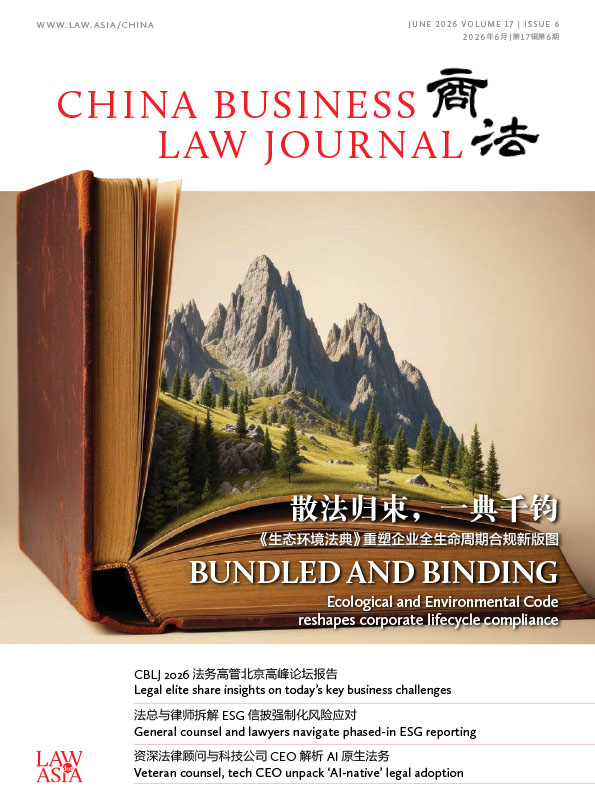








With disputes business undoubtedly overshadowing transactional work in jittery legal markets, John Quinn, from US-based disputes law firm Quinn Emanuel, reveals the secrets behind his firm’s success, offers insights on China’s legal talent pool and strategies for navigating international tensions. Luna Jin speaks with the founding partner of the world’s ‘most feared’ law firm
China Business Law Journal: With ongoing tensions in US-China relations, multinational companies caught in the middle face intricate legal risks. What advice do you have for in-house counsel in these companies in managing their dispute risks? Aside from job requirements, do you believe they also have any extra obligation to help better decision-making or adjust risk appetite during such trying times?
John Quinn: In circumstances where there are political and geopolitical tensions, one predictable aspect is change, as nobody possesses a crystal ball.
Consequently, in-house counsel must embody flexibility, agility, and remain thoroughly informed about ongoing trends. Making sure that your company is abiding by the law, not only in China and the US but also in any other relevant jurisdiction where you conduct business, is imperative.
The presence of risks can put a chilling effect on certain business activities, unfortunately, leading some companies to abstain from committing or investing until they have greater clarity. Such decisions are mostly business-related.
However, the businesspeople making those decisions will need the advice of lawyers on how things are crystallising once they begin to crystallise, and a real understanding of any emerging new rules.
Some in-house lawyers wear two hats: they are businesspeople in addition to being lawyers.
A lot of these companies express a desire to avoid unnecessary attention in the media to focus on business development. Therefore, a lot of the decisions are made around that concern as well.
As a lawyer, the foremost priority is understanding the law, ensuring the client is well informed and compliant, and offering the necessary guidance for informed business decisions. Tough business decisions may need to be made during times of tension like this, but a real understanding of what is permissible and what is not will benefit decision-making processes.
It is hard to comment on whether a lawyer should encourage a company to take more risks without a deep understanding of the specific circumstances, as this decision inherently pertains to business considerations.
From our interactions with all our clients right now, the Chinese in-house teams are pretty sophisticated. They understand overseas legal systems and China, and I think they are doing a good job providing valuable advice for informed decision making within businesses.
On a separate note, there are always tough times, tensions and challenges in businesses, so in-house counsel must also expand their knowledge about various different firms and consultants, ensuring they have specialists readily available in their pool, ready to work.
CBLJ: During your China trip, you engaged in extensive discussions with local lawyers and in-house counsel. Did you observe significant differences in professional perspectives, legal culture or business practices between the US and Chinese legal markets? What is your outlook on future collaboration between your firm and Chinese law firms?
Quinn: We have been collaborating with local Chinese firms since before we opened offices in China, over 10 years ago. This is a key part of our strategy.
We, as an international firm, cannot advise on Chinese law, or practise Chinese law. When we have clients who require Chinese law advice, whether for inbound or outbound work in China, we work with local firms. It’s second nature for us. There is a whole list of Chinese firms that we team up with, such as Zhenghan Law Firm, Fangda Partners, JunHe, Zhong Lun Law Firm, DaHui Lawyers and Commerce & Finance Law Offices, and the list goes on.
As for differences in legal culture, every country is different in my experience.
When I first went to London and we opened an office there in 2007, I initially assumed that the legal culture, being English-speaking, would be similar to that in the US. However, I soon realised that the legal culture in the UK is vastly different than it is in the US. Similarly, here in China, the legal landscape is radically different.
In China, there is intense competition among the Chinese firms, and they have grown increasingly sophisticated over time. They now resemble international firms in many ways, but still retain distinct Chinese characteristics.
For example, I have the sense that at many Chinese firms, partners somewhat run their own balance sheets. In other words, they keep track of the work that they originate, the associated costs, and the associates that they employ.
In some ways, it’s like mini law firms within a large law firm. Partners run their own practices within the firm, bearing specific costs and reaping the benefits of generated revenues, which differs significantly from practices in the US.
For our firm, it’s one firm, one pile of money, and one bank account. Our system is not lockstep; rather, we assess individuals’ contributions, taking into account various factors, and it’s not formulaic.
Which one is better? Ultimately, it boils down to a cultural issue and what best serves the firm’s objectives.
If you were to try to transpose the Chinese system to the US, I fear that we wouldn’t be able to foster the unity, teamwork, willingness to sacrifice, and mutual assistance that are so essential to our practice.
In our firm, it’s completely countercultural to be possessive or territorial about clients or relationships. We prioritise assigning the best-suited lawyer to a client based on expertise rather than personal relationships. Compensating individuals based on client relationships could compromise our focus on the firm’s collective success and the client’s best interests.
Moreover, our cases are typically large and complex, requiring collaboration among extensive teams of lawyers with diverse expertise across various locations.
We emphasise a culture where individuals can readily contribute and support each other without negotiations or personal gain considerations. We want people to be able to do that without first having a negotiation about “if I help you, what’s in it for me”.
Our model doesn’t happen automatically, and you can’t simply issue an edict or order telling everybody to be unselfish, or “don’t have sharp elbows”.
It can only be achieved by focusing attention on it, talking about it, being positive about it, and acknowledging good behaviour.
We give out collegiality awards in our firm, recognising partners who have introduced other partners to clients, and broadened our relationships with clients by introducing them to other dispute practice areas.
I’ve been away for over six years, so I can see changes in a way that perhaps people who are here all the time may not notice.
I’m amazed by the growth in the strength of in-house teams, particularly among younger professionals. The talent, diverse backgrounds, educational qualifications from universities outside China, and language proficiency of these individuals are on par with, or surpass, the standards seen in any other country.
You must be a
subscribersubscribersubscribersubscriber
to read this content, please
subscribesubscribesubscribesubscribe
today.
For group subscribers, please click here to access.
Interested in group subscription? Please contact us.
你需要登录去解锁本文内容。欢迎注册账号。如果想阅读月刊所有文章,欢迎成为我们的订阅会员成为我们的订阅会员。