









INTA’s Annual Meeting will address critical issues currently impacting the IP community. Board members Sheja Ehtesham, MS Bharath and Jianguo Wang reveal the topics they expect to take centre stage. Sheryl Ubana and Bimal Mirwani report
The growing use of AI in branding, trademark searches and content creation, coupled with the rise of deepfakes and digital replicas, has introduced new layers of complexity to trademark protection, raising pressing questions around ownership, enforcement and liability. These challenges are particularly pronounced in Asia, where rapid adoption of AI technologies intersects with fragmented legal systems and enforcement gaps.
Against this backdrop, the International Trademark Association (INTA) 2026 Annual Meeting from 2-6 May in London comes at a critical juncture for brand owners and legal practitioners, as AI continues to reshape the intellectual property sector.
INTA’s annual gathering is poised to serve as a key platform for addressing how legal frameworks and enforcement strategies can adapt to a rapidly evolving digital environment.
With strong participation from major jurisdictions such as India and China, INTA board members – Sheja Ehtesham, managing partner at ALG India Law Offices; M S Bharath, founder and managing partner at KRIA Law; and Jianguo Wang, general manager of intellectual property and deputy general manager of brand at Haier Group – tell Asia Business Law Journal what key aspects of IP are likely to be thrust into the spotlight.
The generative AI conundrum
The rise of generative AI is impossible to ignore, and its impact is increasingly evident across the legal sector, particularly within the IP practice. As AI-generated branding, trademark search automation and deepfake-related brand misuse become more prevalent, the need to address trademark protection in an evolving, technology-dominated world has grown more urgent.
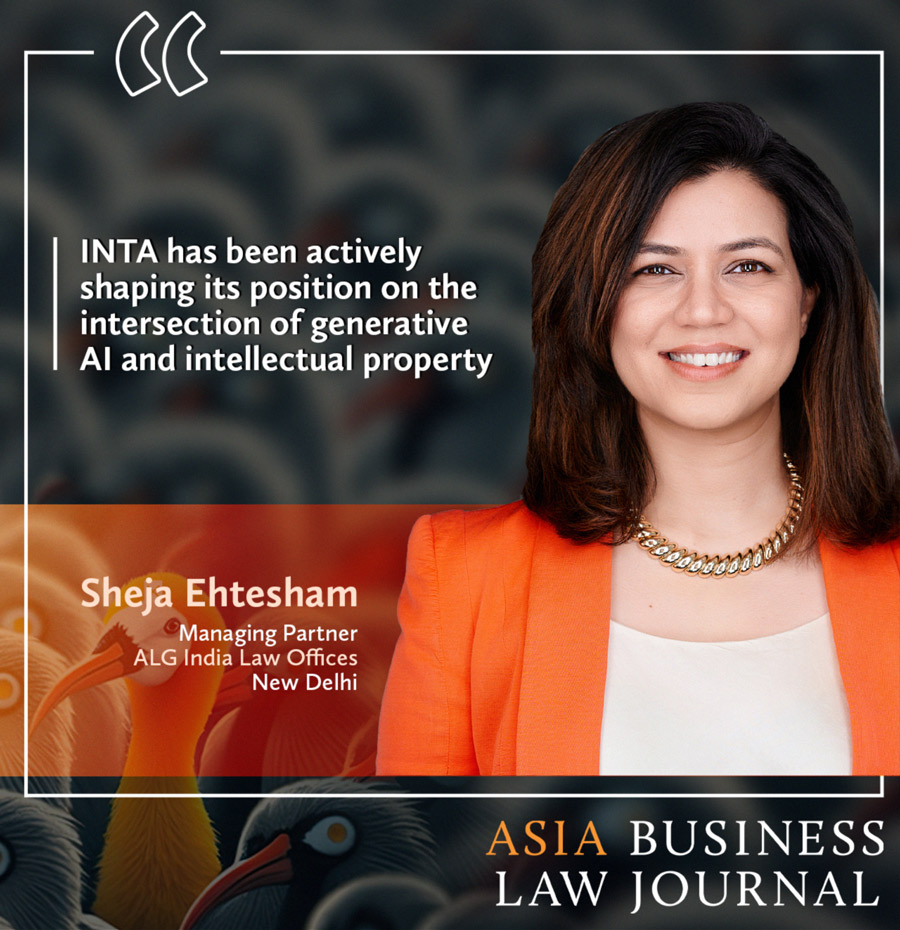
“INTA has been actively shaping its position on the intersection of generative AI and intellectual property, with a focus on ensuring that innovation is balanced with effective protection of brand owners and consumers,” says Ehtesham.
You must be a
subscribersubscribersubscribersubscriber
to read this content, please
subscribesubscribesubscribesubscribe
today.
For group subscribers, please click here to access.
Interested in group subscription? Please contact us.