













In international arbitration, the choice of arbitral seat can set the tone for the entire procedure and therefore warrants careful deliberation. For Marco Chung, group head of legal at CITIC Securities International, one candidate stands out as the most logical choice for parties to China-related disputes
FOR IN-HOUSE COUNSEL involved in negotiating cross-border contracts that may lead to disputes with a PRC party, or involve PRC-located assets, the choice of arbitral seat is one of the most strategically important decisions in contract design.
This article provides a practical, neutral toolkit for evaluating arbitral seats. The key factors are:
-
- Enforceability. Can a party (whether PRC or international) promptly recognise and enforce the award in the PRC against the other side’s assets?;
- Interim relief. Can a party obtain asset freezing, evidence preservation or conduct orders from PRC courts before the final award?;
- Statutory support. Does PRC law endorse the seat, providing legal certainty for all?; and
- Finality. How difficult is it to challenge an award in the courts of the seat?
For years, parties often defaulted to seats such as Singapore or England based on assumptions of “neutrality” or reputation. But recent developments in PRC policy, legislation and judicial practice have fundamentally altered the landscape.
China’s revised Arbitration Law, effective since March 2026, for the first time explicitly encourages parties to choose arbitration seats within China – including Hong Kong. This statutory endorsement benefits both international and PRC parties by eliminating legal ambiguity.
In addition, Hong Kong provides the only offshore access to PRC interim measures and streamlined enforcement – a structural feature that applies equally to all parties, regardless of their nationality.
Comparing notes
Before making a decision, it is vital to understand the broader environment of judicial co-operation between the PRC and the leading common law seats. These frameworks affect the predictability of enforcement for both sides.
PRC-Singapore legal framework. The 1997 Treaty on Judicial Assistance in Civil and Commercial Matters covers arbitration award recognition but not court judgments. This treaty provides institutional co-operation that is absent in the PRC-UK relationship.
The 2018 Memorandum of Guidance (MOG) on Recognition and Enforcement of Money Judgments, signed by the Supreme People’s Court of China (SPC) and the Supreme Court of Singapore, is another important document. While not legally binding, it provides practical guidance.
Furthermore, multiple cases have confirmed mutual recognition of judgments between PRC and Singapore courts, setting up valuable judicial precedents.
PRC-UK legal landscape. There is no bilateral treaty on arbitration or judgment recognition between the PRC and the UK. Recent positive developments – such as SPC guiding case no. 235, issued in December 2025, have improved the landscape but structural gaps remain.
For both international and PRC parties, these differences matter because they affect the predictability of enforcement, not just of arbitral awards but of any associated court judgments.
The table below compares the three most common seats, using the toolkit framework, to help evaluate the balance and efficiency of each option.
Checklist for in-house counsel
The checklist below can be used when negotiating or reviewing arbitration clauses in international contracts involving a PRC party or PRC-based assets.
Start with enforceability from both sides. If your counterparty has assets in the PRC, prioritise seats with streamlined PRC enforcement pathways. Hong Kong offers efficient enforcement.
Assess “foreign element” risk early. In relation to PRC domestic disputes, many transactions involving Hong Kong or Greater Bay Area (GBA) parties do not meet traditional thresholds for foreign-related disputes such that parties historically had to choose a PRC domestic seat until recently.
Hong Kong is currently the only offshore seat where Hong Kong-funded enterprises registered in the nine GBA cities can lawfully and reliably choose Hong Kong as an offshore seat without facing invalidity risks.
Prioritise interim relief capability. Asset dissipation is a leading threat to successful recovery. Hong Kong’s exclusive access to PRC interim measures allows parties to freeze assets, preserve evidence and obtain conduct orders before or during arbitration – an advantage no other offshore seat can match.
Understand the broader judicial relationship. If your business may need to enforce court judgments as well as arbitral awards, Singapore’s treaty and MOG framework offers more predictability than England, but Hong Kong’s full integration with the PRC judicial system makes it a unique arbitral offshore seat.
Align seat, institution and governing law. Mismatched clauses create jurisdictional risks for both sides. Ensure the seat, administering institution, procedural rules and substantive law can work together in a coherent manner.
Account for operational practicality. Time zone alignment, bilingual procedures, hearing flexibility and institutional efficiency reduce cost and delay for all parties. Hong Kong’s proximity to the PRC and bilingual common law system offers practical convenience.
Key question: Does the seat give one side a structural advantage in PRC enforcement? If the answer is yes, e.g. a seat with no PRC interim measures may favour the party with assets outside the PRC, reconsider.
The optimum choice
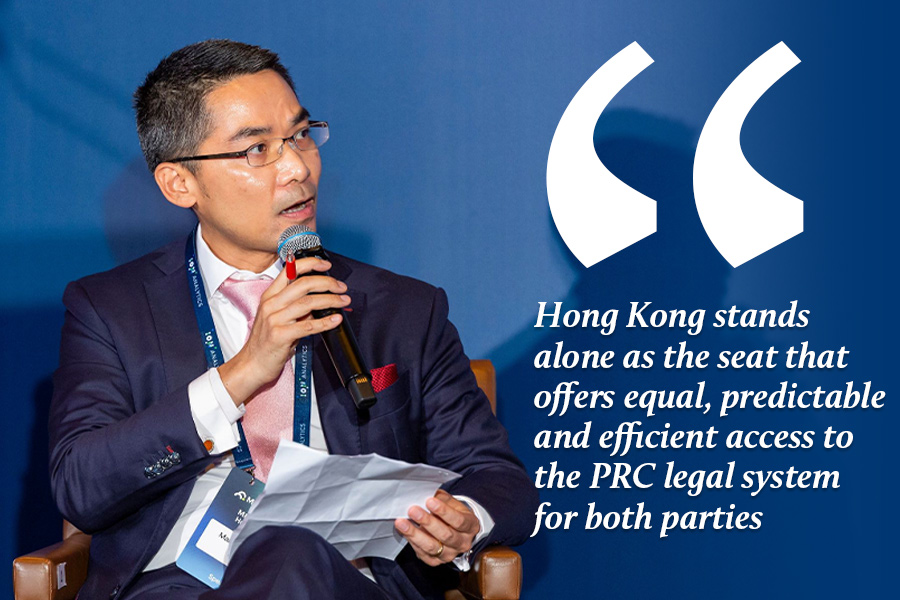
When evaluated through the lenses above, Hong Kong stands alone as the seat that offers equal, predictable and efficient access to the PRC legal system for both parties. Four structural advantages support this position:
-
- Statutory endorsement by the PRC. China’s revised Arbitration Law explicitly encourages parties to choose the PRC (including Hong Kong) as a seat. This eliminates legal uncertainty for both international and PRC parties, unlike Singapore or England, where PRC law gives no statutory endorsement.
- Exclusive access to PRC interim measures. Only Hong Kong-seated arbitrations allow parties to apply to PRC courts for asset freezing, evidence preservation and conduct orders before the final award. This right is available to both sides equally; an international party can seek to freeze a PRC party’s assets, and a PRC party can seek to freeze an international party’s assets in the PRC. No other offshore seat offers this.
It should be noted that after arbitration is accepted, applications must be transmitted via the arbitral institution. Pre-acceptance emergency applications may be filed directly, with courts required to rule within 48 hours. - Streamlined enforcement. Under the Mainland-Hong Kong Mutual Enforcement Arrangement, awards from Hong Kong-seated arbitrations benefit from a faster, more predictable recognition process than foreign awards under the New York Convention. Again, this applies equally to all parties, regardless of which side has to enforce.
- Exceptional finality. Hong Kong courts consistently refuse to reopen arbitral awards on the merits, and the indemnity costs regime penalises unmeritorious challenges. This gives both sides confidence that a favourable award will be the end of the dispute, not the beginning of a new round of litigation.
For these reasons, Hong Kong is not a seat that favours PRC parties or international parties – rather, it is a seat that removes the historical enforcement asymmetry. International parties gain reliable access to PRC asset protection and enforcement. PRC parties gain a seat that does not put them at a disadvantage simply because they are from the PRC. This balance is why Hong Kong is the most rational choice for any international dispute with a PRC nexus.
HK-funded, HK arbitration
A recent case in Shenzhen demonstrates Hong Kong’s unique position to provide equal, predictable and efficient access to PRC enforcement mechanisms in international disputes with a PRC nexus.
In this case, a Hong Kong-funded enterprise registered in Qianhai, Shenzhen, and a PRC individual entered into a contract. They agreed on Hong Kong as the arbitral seat, with hearings physically held in the PRC, and the PRC law as the substantive law. The arbitration was administered by the Hong Kong affiliate of the Shenzhen Court of International Arbitration (SCIAHK).
After the award was issued, the successful party applied to the Shenzhen Intermediate People’s Court for recognition and enforcement. The court held that:
-
- The arbitration agreement was valid;
- The Hong Kong-funded entity was entitled to choose Hong Kong as the arbitral seat without proving a separate “foreign element”; and
- The award was recognised and enforceable in the PRC.
The entire process from application to enforceable order took just 1.5 months.
This judgment resolved a longstanding concern for both international and PRC parties. For international parties, it confirms that a Hong Kong-seated award can be enforced swiftly and predictably against PRC-based assets. For PRC parties, it confirms that Hong Kong offers the same predictable enforcement that can be applied equally if the international party was the respondent.
Crucially, the case demonstrates that Hong Kong provides balanced enforceability: the streamlined PRC enforcement mechanism is available to any party that obtains a Hong Kong award, regardless of whether that party is Chinese or foreign. This removes the risk that a seat might favour one side’s enforcement prospects over the other.
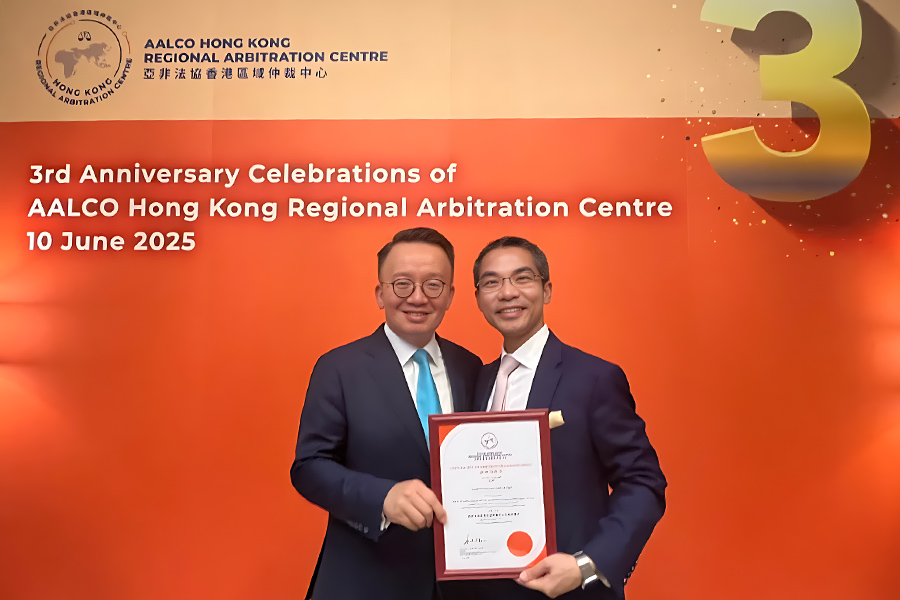
Marco Chung is a fellow of the Chartered Institute of Arbitrators and a panel arbitrator of the Dubai International Arbitration Centre, Shenzhen Court of International Arbitration (SCIA), Shanghai International Arbitration Centre (SHIAC), and Asian-African Legal Consultative Organisation (AALCO) Hong Kong Regional Arbitration Centre