










The Ericsson v Lava judgment shows that courts do not condone unlicensed use of standard essential patents, and affirms the country’s position as a jurisdiction where IP rights are protected. Freny Patel reports
A turf war between smartphone manufacturers and standard essential patents (SEP) owners intensified in India in March as a Delhi High Court judge – relying heavily on foreign legal precedents – ruled that royalties for SEPs in India should be calculated on end-device pricing rather than chipset pricing.
Adjudicating in favour of Ericsson in a patent infringement lawsuit against Indian smartphone manufacturer Lava Mobiles, Judge Amit Bansal awarded the Swedish global major damages of INR2.44 billion (USD29.29 million) plus 5% annual interest until paid.
This is the highest amount of damages awarded in any patent or IP-related matter in India to date. The royalty rate was set at 1.05% on the net sales value of smartphones sold by the Indian mobile manufacturer from 1 November 2011 to 8 May 2020. Ericsson was also awarded the costs of the lawsuit.
The Ericsson-Lava judgment is only the second post-trial decision dealing with SEPs in the Indian context. The first post-trial SEP judgment came in July 2018, dealing with a Philips patent case over DVD technology.
In Ericsson-Lava, Delhi High Court acknowledged Ericsson’s entitlement to damages for the loss of royalties or licence fees.
“Had Lava entered into a licence agreement with Ericsson at the time it started selling its products in India, Ericsson would be entitled to royalties on FRAND [fair, reasonable and non-discriminatory] terms,” said Judge Bansal. “Since this was not done, Ericsson rightly claimed damages based on the amount of royalties it would have earned, calculated on FRAND rates.”
The 476-page Ericsson-Lava judgment says that Lava’s “lack of responsiveness to Ericsson’s offers, and even the court’s queries, collectively demonstrate a pattern of behaviour that is inconsistent with the principles of fair and constructive negotiation. Consequently, Lava can aptly be described as an ‘unwilling licensee’ in respect of Ericsson’s SEPs.”
Saya Choudhary Kapur, senior partner at Singh & Singh in New Delhi, represented Ericsson and applauded the judgment as “momentous” in dealing with SEPs and patents. Kapur says the judgment affirms India’s position as a jurisdiction where IP rights are recognised and protected. He praises India’s “robust judiciary system”, which does not discriminate between an Indian entity and a non-Indian entity.
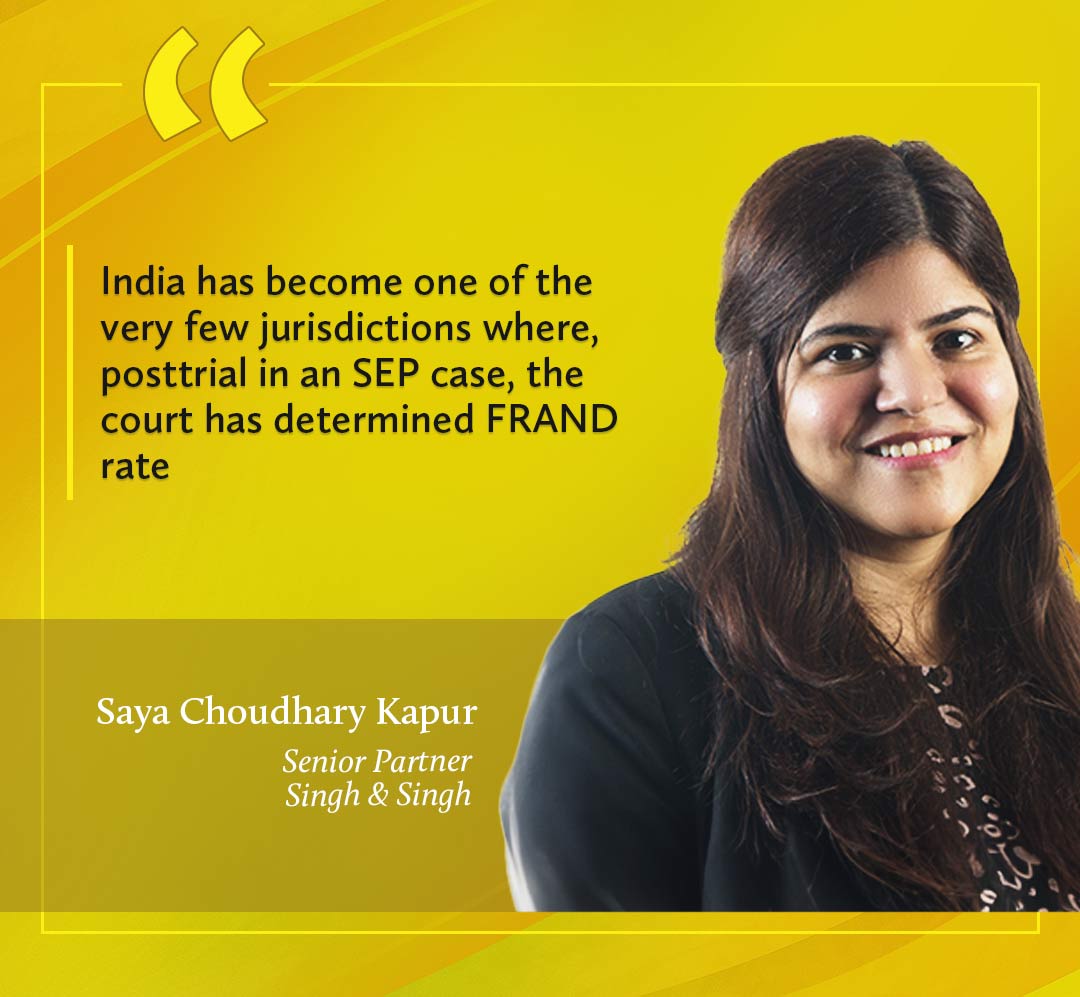
“India has become one of the very few jurisdictions where, post-trial in an SEP case, the court has determined FRAND rate,” Kapur says.
Swati Sharma, partner and head of the intellectual property practice at Cyril Amarchand Mangaldas in New Delhi, says the size of the penalty is bound to improve India’s image internationally as an IP-friendly jurisdiction and may pave the way for other such litigations where the successful party is awarded substantial damages along with actual costs.
In addition to damages and legal fees, the court also addressed several critical issues on patent litigation including patentability, inequitable conduct, validity, exhaustion, standard essential patents and FRAND terms. Judge Bansal ruled that a licence fee should apply to all standard-compliant infringing devices and not just tested ones.
Abhay Porwal, the head of operations at IPpro Services India, a company founded by Nishith Desai, the managing partner of Nishith Desai Associates, says a major takeaway from the judgment is the importance of “having an ecosystem where other industry players have reasonable access to SEPs along with protecting the rights of the patent owners in enforcing the patents”.
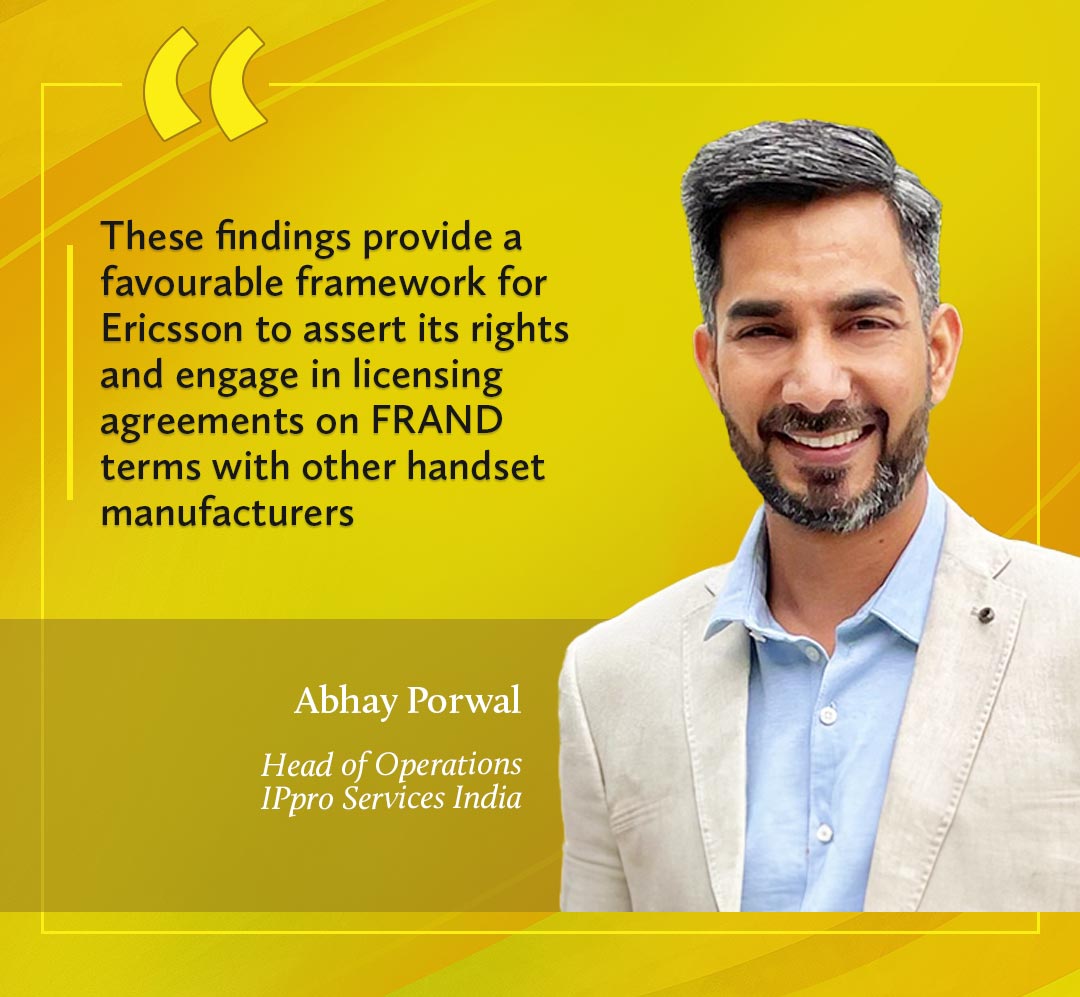
Porwal, who also leads the patent drafting and analytics group at Nishith Desai Associates, says that in calculating the licence fee based on the end-product and not just the chips used in the devices, the court acknowledged the integral nature of Ericsson’s innovations within Lava’s devices. “These findings provide a favourable framework for Ericsson to assert its rights and engage in licensing agreements on FRAND terms with other handset manufacturers.”
The judgment – the first final judgment in a telecoms SEP matter passed after a full trial – goes into the issue of how to calculate damages in SEP cases. Noida-based Fidus Law Chambers’ managing partner Shwetasree Majumder points out this has “no precedent”.
The judgment holds that comparable licensing is a preferred method for calculating FRAND, and that FRAND calculations should be based on the end-user product and not on the smallest saleable patent practising unit (SSPPU), says Majumder.
You must be a
subscribersubscribersubscribersubscriber
to read this content, please
subscribesubscribesubscribesubscribe
today.
For group subscribers, please click here to access.
Interested in group subscription? Please contact us.
你需要登录去解锁本文内容。欢迎注册账号。如果想阅读月刊所有文章,欢迎成为我们的订阅会员成为我们的订阅会员。
Read the related article here:
Late but worth the wait? Decoding Ericsson v Lava verdict
The recent FRAND (fair, reasonable and non-discriminatory) rate-setting decision from Delhi High Court (DHC) in the dispute between Ericsson and the Indian mobile maker Lava shines a light on India as a country of interest for standard essential patent (SEP) litigation
For more related stories, visit law.asia.