

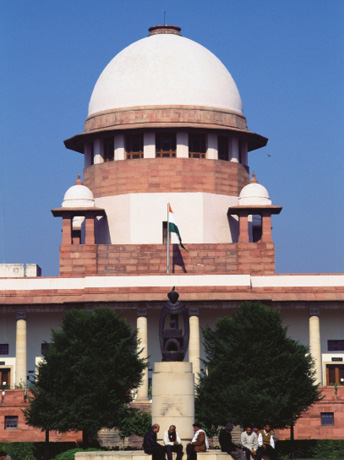
A five-judge constitution bench of the Supreme Court recently held that parliament did not have the power to legislate on extra-territorial aspects or causes that have no direct or indirect, tangible or intangible impact on the territory of India, or on the interests and welfare of its inhabitants. In making this ruling in GVK Industries Ltd & Anr v The Income Tax Officer (ITO) & Anr the court went against the Attorney General’s proposition that parliament, as a sovereign legislature, did in fact have such powers under article 245 of the constitution.
 GVK, a big player in the infrastructure sector, had engaged a Swiss company to help it raise finances. The company asked the tax authorities for a “no objection certificate” under section 195 of Income Tax Act, 1961, before making a remittance to the Swiss company. It was refused. This triggered a writ petition before the Andhra Pradesh High Court which ruled that the payment of “fees for technical services” were taxable in India under section 9(1)(vii) of the act. The court also rejected GVK’s argument that section 9(1)(vii) was unconstitutional for want of legislative competence.
On appeal, the Supreme Court considered if 1) the constitution does indeed restrict parliament from enacting legislation with respect to extra-territorial aspects or causes that have no effect on the territory of India or the interests and welfare of India’s inhabitants; and 2) parliament can legislate for any territory, other than the territory of India or any part of it.
You must be a
subscribersubscribersubscribersubscriber
to read this content, please
subscribesubscribesubscribesubscribe
today.
For group subscribers, please click here to access.
Interested in group subscription? Please contact us.
你需要登录去解锁本文内容。欢迎注册账号。如果想阅读月刊所有文章,欢迎成为我们的订阅会员成为我们的订阅会员。
The update of court judgments is compiled by Bhasin & Co, Advocates, a corporate law firm based in New Delhi. The authors can be contacted at lbhasin@bhasinco.in or lbhasin@gmail.com. Readers should not act on the basis of this information without seeking professional legal advice.