













The tapestry of legal services in this historic city extends far back and to far more than litigation alone. Manokamana unravels threads of nuance in the south Indian city’s legal industry
Located in the southern state of Tamil Nadu, Chennai, formerly known as Madras, is a historic major port city that has seen centuries of legal and commercial development.
The city served as the capital of the Madras Presidency, one of the three major presidencies under British colonial rule, which included many parts of present-day Andhra Pradesh, Tamil Nadu, Kerala, Karnataka, Odisha and Telangana.
From the setting up of one of the first high courts in the country, to having multiple legal professionals going on to hold government positions rarely held by Indians in British India, the city and its court have contributed significantly to the history of the country.
Chief among those legal personalities that not only contributed to jurisprudence but also to the fight for the freedom of India are such luminaries as Sir Chettur Sankaran Nair, Sir V Bhashyam Aiyangar, and Seshadri Srinivasa.
“Madras High Court has a legacy attached to it,” says Srinath Iyengar, managing partner of the Chennai and Surat offices of Fox Mandal & Co. “The court originated from Letters Patent issued by Queen Victoria in 1862, under the Indian High Courts Act of 1861, merging the Supreme Court of Judicature at Madras [active since 1801], and the Sadr Diwani Adalat [appellate court established by British powers in 1772].”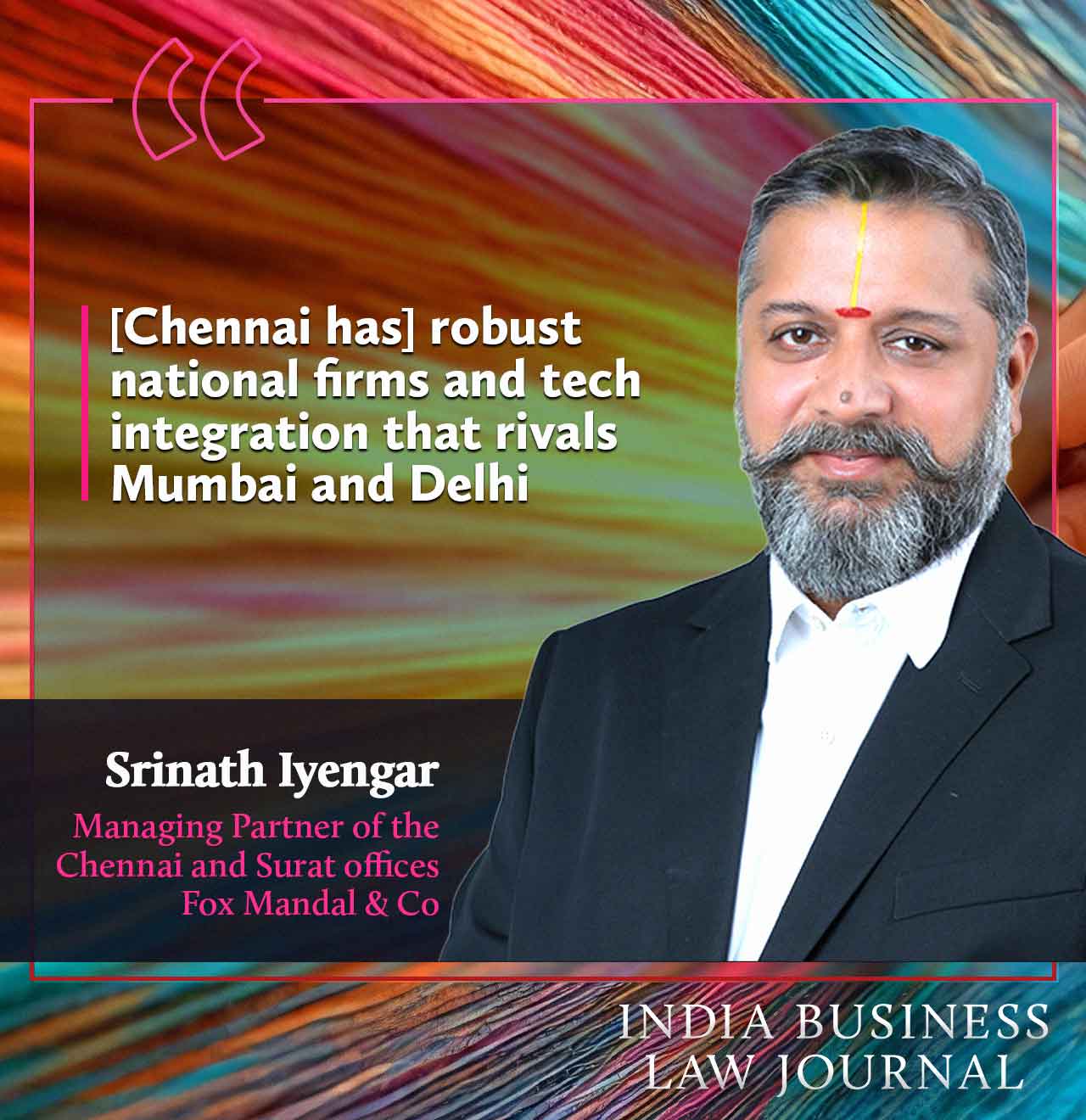
Raja Pannir Selvam, managing partner at Selvam & Selvam, says Chennai has “a longstanding tradition of litigation and a robust bar, which continue to shape the nature of legal practice here”.
He is quick to point out, though, that litigation is not the only kind of legal work prevalent in the city. “Chennai hosts highly specialised practices and handles complex, high-value matters, particularly in IP and manufacturing.”
Iyengar says a common myth is that “Chennai practice has more traditional law firms, and that it lags other tier-1 cities in quality; in reality, [the city has] robust national firms and tech integration that rivals Mumbai and Delhi.”
Savitha Jagadeesan, a senior resident partner at Kochhar & Co also agrees, observing that “most of the time, the focus remains on the three main regions [Delhi, Mumbai and Bengaluru], and Chennai, which has a vibrant legal market, gets left out”.
To bring this vibrant legal market into the spotlight, India Business Law Journal spoke to legal professionals engaged in different practice areas in the city.
A commercial city
Just like other tier-1 cities, Chennai has its own legal commercial market conditions and strengths. Iyengar, of Fox Mandal & Co, even refers to Chennai’s “better work-life balance and lower costs” compared to Mumbai and Delhi. “It gives you the best of both worlds,” he says.
Vivekanandh Sellamuthu, managing partner of SMV Chambers, has experience in litigation in several tier-1 cities. “Having practised law in Delhi and Mumbai, and studied in Bengaluru, I can say with clarity that practising law in Chennai is fundamentally different from practising in any other city,” she says.
“Chennai has traditionally been strong in litigation and disputes, particularly commercial litigation, arbitration, and matters before regulatory and statutory tribunals. It is an MSME-driven [micro, small and medium enterprises] economy, therefore numerous industries and family businesses look towards legal support … with respect to commercial disputes, infrastructure, IP, employment and company law.”
As to the key sectors, Kavitha Vijay, a senior partner at Chugh Universal Legal says: “Chennai’s legal market blends our strong traditional sectors like manufacturing, infrastructure, shipping and family businesses with fast-growing areas such as automotive, renewable energy, healthcare, tech services and private equity.”
Sellamuthu adds ports, logistics, real estate, employment and labour law to the list. “With GCCs [global capability centres] booming and international arbitration on the rise, the work here is as global and dynamic as anywhere.”
Vijay says all of this often leads to years-long associations between a given company and its lawyers. “In my practice, much of this [corporate work] evolves into multi-year advisory roles where we serve as true strategic partners.”
On-ground advantage
With their strong presence in litigation and corporate advisory work, Chennai-based lawyers and their firms believe they can often outperform their counterparts from bigger cities.
Jagadeesan, at Kochhar & Co, says: “The real strength does not lie in size or brand, but in contextual dominance, the ability to operate seamlessly within the city’s legal, institutional and cultural ecosystem. This advantage is real, enduring and extremely difficult to replicate from outside.”

Vinay Bhagawan, head of legal & compliance, CSR at Daimler India Commercial Vehicles, agrees. “Chennai-based law firms are primarily engaged for work that requires strong local forum presence and on-ground execution,” he says.
“Their familiarity with the Madras High Court’s procedures, registry practices and forum dynamics enables quicker movement and better predictability. They are also significantly stronger when it comes to on-ground co-ordination, urgent filings, evidence collection, and engagement with local authorities.”
This local expertise is not just appreciated by corporates in the city but also firms in other cities that ultimately end up engaging local counsel for the “last mile” of Chennai-based projects.
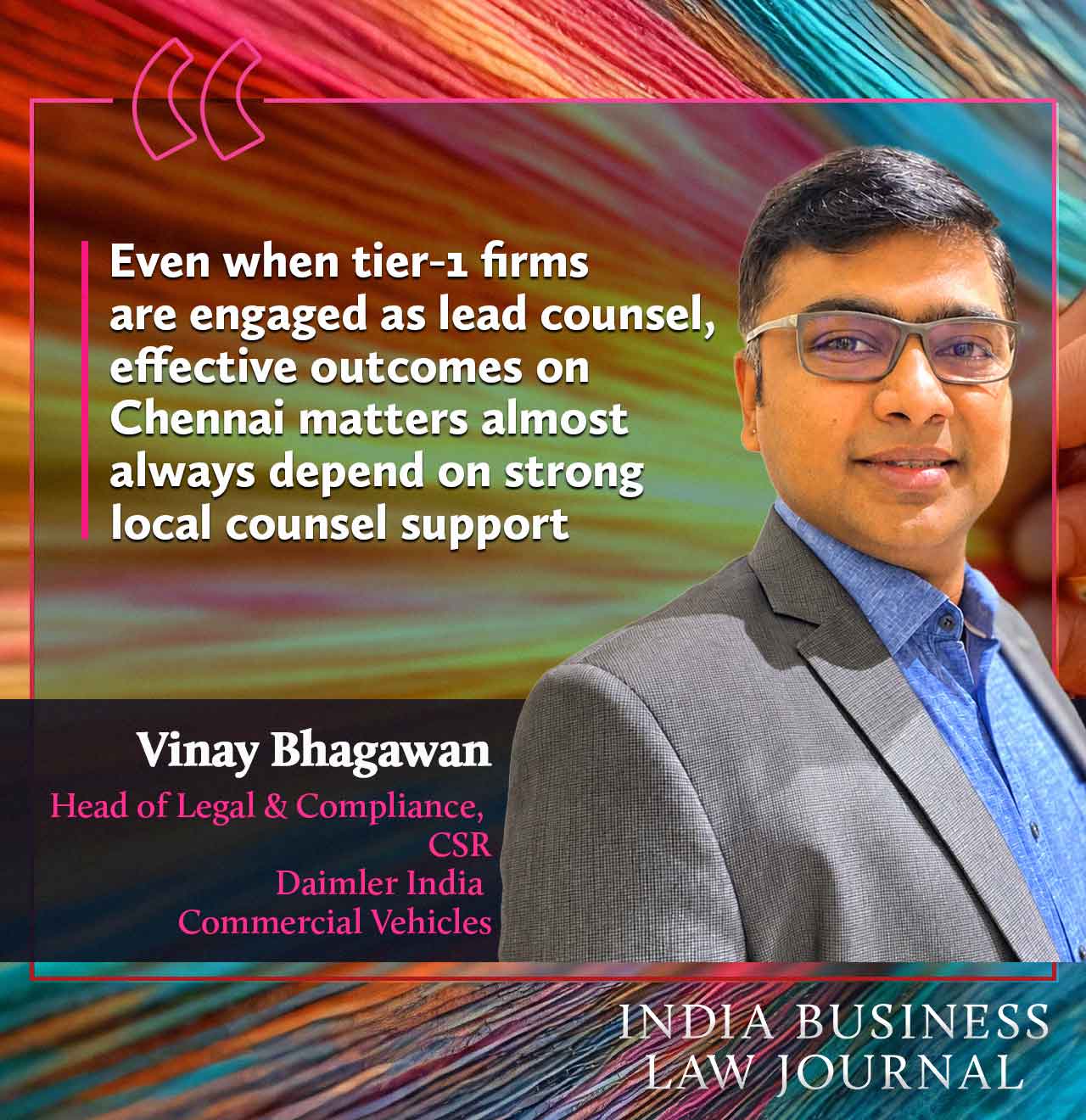
“Local insight often outweighs the benefits of large national platforms,” says Bhagawan. “Even when tier-1 firms are engaged as lead counsel, effective outcomes on Chennai matters almost always depend on strong local counsel support.”
“Chennai firms tend to be more pragmatic and outcome-oriented, especially in disputes and regulatory matters. Advice is often grounded in what is likely to work locally, rather than being overly theoretical,” he adds.
Jagadeesan also credits the professional camaraderie existing between bar and bench as an added advantage of Chennai-based lawyers. According to her, “this lived familiarity is not something that can be quickly imbibed; it is a way of practice that directly translates into more effective and grounded advocacy”.
Cultural nuance
Simply put, legal work in a given location often has its own quirks stemming from established local practices and culture.
“To understand the nuances of local commercial sensibilities is a strength that only lawyers embedded in Chennai’s ecosystem can truly bring to the table,” says Jagadeesan. “The practice of law is rooted in relationships with clients, not in the size of the fee or the scale of the matter. You are expected to bring the same commitment, rigour and integrity to a small brief as you would to a high-stakes dispute.”
“Chennai is a capital-rich but conservative city,” suggests Srinath Sridevan, an independent senior counsel practising before the High Court of Madras. “The best way to get a client here is word of mouth. It doesn’t matter how big a name you are, if the human being at the heart of the big-name firm is not known to the industry heads, they will not engage that firm.”
Retaining that lawyer-client relationship is, then, all about mutual trust and respect.
“In Chennai, respect goes a very long way,” says Jagadeesan. “Respect for clients, for colleagues, for the court and for local practice norms. Equally important is the willingness to collaborate and to understand the ecosystem before seeking to shape it. Once you do, the city rewards you, not loudly, but enduringly.”
SMV Chambers’ Sellamuthu says Chennai’s legal market “tends to be more relationship-driven and less transactional volume-heavy. Clients here value continuity, accessibility and practical advice over form. “Chennai is distinct because it functions almost like a hybrid. It has the complexity and sophistication of tier-1 work, while still retaining the cost sensitivity and grounded approach more typical of tier-2 markets.”
Mind your language
Navigating the culture in Chennai goes necessarily hand-in-hand with one’s skill in Tamil, the language commonly spoken in the state.
“Tamil plays a very meaningful role in legal work in Chennai,” says Jagadeesan. “Though English is the formal language of work and all briefings, court matters are [conducted in Tamil] – it creates a clear advantage for a practitioner.”
Daimler’s Bhagawan says many underlying documents such as land records, employment documents, local authority communications, inspection reports and witness statements are in Tamil. “For matters involving district authorities, labour offices, police, or local bodies, familiarity with Tamil significantly improves speed, accuracy and effectiveness,” he says.
However, this does not mean that knowledge of Tamil is imperative for legal work in the city. Sridevan observes that, apart from in litigation, “in no other segment will language be a barrier of any significance … so long as you can speak English, you will find people are wonderfully welcoming.”
Competing with big city firms
Corporate advisory and litigation sometimes require that Chennai-based legal professionals must collaborate with counterparts in bigger commercial cities.
“I would say for every five matters pending before the original jurisdiction [of the high court], you will need co-ordination with firms from tier-1 cities or international [firms] in at least two,” says Rajesh Ramanathan, a partner at Factum Law.

Selvam says co-ordination with tier-1 firms and international counsel is frequent, especially in cross-border transactions, international IP portfolios, enforcement actions involving multinational clients, and complex disputes. “Chennai-based firms often act as local counsel or regional specialists, collaborating closely with larger firms and global law firms,” he says.
When the work can be done wholly in Chennai, though, a final and often telling advantage of the city is found on the bottom line. According to local legal professionals, the city delivers budget-friendly legal advice without compromising on expertise.
“The bill is about 10-15% lower than in the other tier 1 cities,” says Kiran Gupta Rayapati, general counsel and head of legal at HyFun Foods. “They are also flexible in their payment terms and timelines.”
Bhagawan, at Daimler, agrees that Chennai-based firms are generally more flexible and practical in their billing structures. “From an in-house perspective, Chennai firms often offer better cost-to-outcome efficiency for local matters.”