







Due diligence teams work tirelessly to prevent problems, foresee issues and, where necessary, administer a pound of cure. Manokamana reports
In the world of legal transactions and deals, ensuring every detail and process is sound, thorough and without any error is of crucial importance. This task is far more complicated than it may appear, so much so that just one action within the process may have multiple due diligence teams handling different types of research and completion surrounding it.
And yet, due diligence is often the less publicised portion of a legal accomplishment. Rarely does legal pay homage to its experts that ensure the paper chase results in a clear and confident way forward for the business of the transaction and the contract.
So, let’s ask the question, just what is due diligence? The answer is often either too simple or too complex. Simply put, as a general definition, it is taking the necessary steps to ensure things go smoothly.
However, regarding legal, an interesting factor about carrying out due diligence is that it changes markedly depending on the area of practice and type of transaction or development, which brings us to the complex version of the answer.
Due diligence in law includes, but is not limited to, document verification, prior performance records, vetting, regulatory confirmations, etc. These are just some of the most common tasks undertaken as part of performing due diligence, and only a fraction of the complete picture. The rest of it is as deep and complex as the nature of the development, and its field of focus.
Safir R Anand, a senior partner and head of trademarks, contractual & commercial IP at Anand and Anand in Delhi, says: “Today’s economy is brand-driven, reputation-driven and IP-driven, which makes due diligence not just a formality but a core risk-management tool.”

Towards a definition
The spirit behind due diligence is that of caveat emptor, says Taskeen Pirani, associate partner at Dentons Link Legal in Mumbai. “Caveat emptor is a Latin phrase that means ‘let the buyer beware’,” she explains. “It essentially puts the onus on a consumer (buyer) to examine the tangible or intangible property (asset) before it is purchased, and details of what is being offered by the seller.”
Another apt analogy is used by Anand: “Think of due diligence as the legal world’s version of a full-body health checkup before you make an important decision. Due diligence is essentially the process of verifying three things: what exists – the assets, rights, contracts, intellectual property, liabilities; who owns it – the chain of title, authorship, registrations or control; and what can go wrong – litigations, inconsistencies, encumbrances, infringements or reputational risks.”
Siddharth Gupta, a Delhi-based partner at Trilegal, adds: “The diligence can be proactive, i.e. before the investment is committed, as well as reactive, i.e. monitoring the investment post-closing.” The idea is to get a clear and complete picture of what the client is getting into.

Anand says: “Every transaction is a 360-degree exercise. You cannot look at a business from one angle. Its tax history, IP chain of title, litigations, compliance culture, contracts, founders’ reputation; all these pieces must fit together.”
Karun Prakash, a Delhi-based partner at Shardul Amarchand Mangaldas & Co, describes it as “an exercise undertaken to verify whether the information provided by the counterparty in any transaction is true and correct, or if there are any skeletons in the closet that a party should be aware of”. He adds: “It has also become fairly common to [check] … the counterparty’s compliance with anti-bribery, anti-money laundering and sanction laws.”
The conclusion of this exercise gives the team what it needs – a definitive picture of challenges to overcome, and answers to many important questions.
But does this mean a client and a counterparty approach each other with suspicion, expecting deceptions? Lawyers say that is the wrong thought process. The intention is to be cautious and prepared, but not create an atmosphere of misunderstanding.
“It is not about mistrust, but about clarity,” says Anand. “It is the difference between stepping into a transaction with headlights on versus driving blind at night. A lawyer who does not conduct proper due diligence is like a doctor who prescribes without diagnosis.”
So, the significance lies in getting things right, but also in preventing adverse outcomes. “The penalty for getting something wrong, whether it is a data breach, an ad code violation, or a labour lapse, can be severe and public,” notes Anand. “This has turned diligence into a far more forensic and preventive exercise than it ever was.”
The findings may severely influence outcomes, as Prakash observes: “Findings are factored into the parties’ [decisions] when determining the transaction structure, and risks identified in due diligence are typically sought to be addressed as valuation adjustments, conditions precedent to the transaction, conditions subsequent to the transaction, or indemnity protections from the counterparties. At times, results of due diligence may also force a party to walk away from a deal.”

Crucial teamwork
Saurav Kumar, a Delhi-based partner at CMS IndusLaw, says typically due diligence involves “a comprehensive review of different aspects of a target to gain a holistic understanding of the company’s overall health, regulatory compliance, and future prospects”. Although this refers particularly to corporate law, it is also applicable to other practices of law.
Generally, the gigantic task of conducting different aspects of due diligence can be shared by multiple teams working together towards a common goal.
Prakash believes good teamwork is essential. “India is a regulatory-heavy jurisdiction and … it is therefore not possible to take a one size fits all approach when conducting due diligence on Indian entities, and it is important to have specialist expertise when conducting due diligence of Indian companies.”
Anand expands on this complexity: “Every Indian state has different rules for stamp duty, different kinds of registration, labour compliance, local taxes and environmental permissions, and a transaction spanning multiple states may invite multiple complexities.”
To address these complexities, Prakash says he has specialist teams looking over their specific areas of expertise when conducting any due diligence.
Anand says each diligence angle should get its own dedicated mini team. “A lead partner sets the tone by mapping out the different workstreams such as corporate, tax, IP, litigation, regulatory, finance, and sometimes even ESG and reputational checks,” he says.
“Each stream is then assigned to specialists who understand the nuances of that discipline. Every team maintains its own internal issue tracker, but key discoveries may be recorded in a master list. This constant back and forth ensures that no issue is viewed in isolation.”
Noorul Hassan, a Hyderabad-based executive partner at Lakshmikumaran & Sridharan Attorneys, says work allocation is generally tiered by expertise and experience.
Kumar says his firm’s lawyers generally conduct legal due diligence on a target that looks back three years. “A central co-ordinating team ensures that findings are consistent across workstreams, cross-referenced where risks overlap, and integrated seamlessly into the overall risk assessment.”
With multiple due diligence teams for one task, from different practice areas, overlaps are bound to occur, which, according to Anand, sometimes may be intentional for added co-operation and scrutiny. But instead of this turning into a situation where everyone is stepping on toes, it allows the team to double-verify their findings and co-ordinate their approach.
Prakash says: “Findings often overlap with findings from other streams [after which it] becomes a collective effort across legal advisers, other advisers and the client.”
Rashi Saraf, Bengaluru-based partner at CMS IndusLaw elaborates: “It is very important to remain in touch with the [other] due diligence teams. Findings by one team may have a consequent impact on the other streams as well. Effective due diligence requires constant co-ordination.”
Anand dubs this as “a carefully choreographed exercise in cross-functional communication”, adding that “the most successful diligence exercises are those where the teams operate not as isolated experts but as a single, interconnected unit, constantly feeding and refining each other’s insights to help clients make fully informed decisions”.
Finally, says Gupta, the outcomes from different due diligence components form various aspects such as conditions precedents, representations, warranties and indemnities, which together impact the overall work.
Pirani says this final report is provided to the client “with any foregoing issues and legal analyses, and advice on the same”.
The components of the final report vary as per the nature of the task and applicable practice areas, but the essence remains the same – making the client aware of where they stand and what is around them.

Papers to screens
Due diligence today has changed a lot from how it was once done. “Lawyers often dealt with inconsistent paperwork and physical documents that travelled through courier packets, or had to be manually inspected in offices and warehouses,” recalls Anand.
Significant respite has occurred due to technology. “Today, the same exercise happens inside secure virtual data rooms, with instant indexing, audit trails and analytics,” says Anand.
Pirani says these data rooms are attractive to the parties involved due to confidentiality. “Platform built-in tools can be used to regulate and track who has access to its data, further access can be limited to a ‘review only’ basis, or the recipient can take prints of certain documents, etc.,” she says.
The evolution of due diligence in the legal world has undergone a cultural shift as well. “Earlier, due diligence was something a buyer did before acquiring a business,” notes Anand. “Today, companies themselves maintain ‘diligence-ready’ data rooms, clean up their IP portfolios, formalise undocumented relationships, and standardise internal compliance before they even approach a deal. Founders understand that the state of their documentation directly influences valuation. In other words, diligence has evolved from a reactive, transaction-bound process into a continuous hygiene mechanism.”
Prakash observes that, with digital access to documents, lawyers are now able to “ask more questions, review documents round the clock and also revisit documents”.
Anand adds that rapid technological adaption has not only accelerated the pace of diligence but also “raised the standard of what is considered acceptable verification”.
Speaking about the use of artificial intelligence (AI) for due diligence, Anand says: “AI-enabled review systems are moving beyond simple contract extraction to genuinely intelligent assistance, spotting patterns of risk, flagging gaps across large data rooms, predicting potential litigation exposure, and even benchmarking compliance levels against industry standards.”
Prakash credits AI for making the process quicker and more efficient. “AI will definitely help in not only making due diligence more accurate, but also in shortening timelines to complete due diligence.”
But he cautions that AI should only be used as a tool, not as a substitute for qualified professionals. This sentiment is echoed by Anand: “AI has not replaced lawyers but has made them faster, sharper, and more capable of handling the vast data sets that modern transactions involve.”
Challenges to overcome
Anand says the most challenging aspects of due diligence in the Indian context “could be the existence of fragmented records, as India may not have a single, unified system for property ownership, business filings, some kinds of IP data and judicial records”. He adds that different states maintain records differently, many archives remain non-digitised, and updates may be delayed.
Prakash, adds that, in the absence of a centralised database, “advisers have to rely on representations and information made available from the counterparty … records relating to title are not always maintained digitally and/or are incomplete and are often maintained in the local vernacular language”.
Kumar also highlights the language barrier: “Obtaining accurate translation is a time-sensitive concern and errors can lead to potential misinterpretation of key legal issues.”
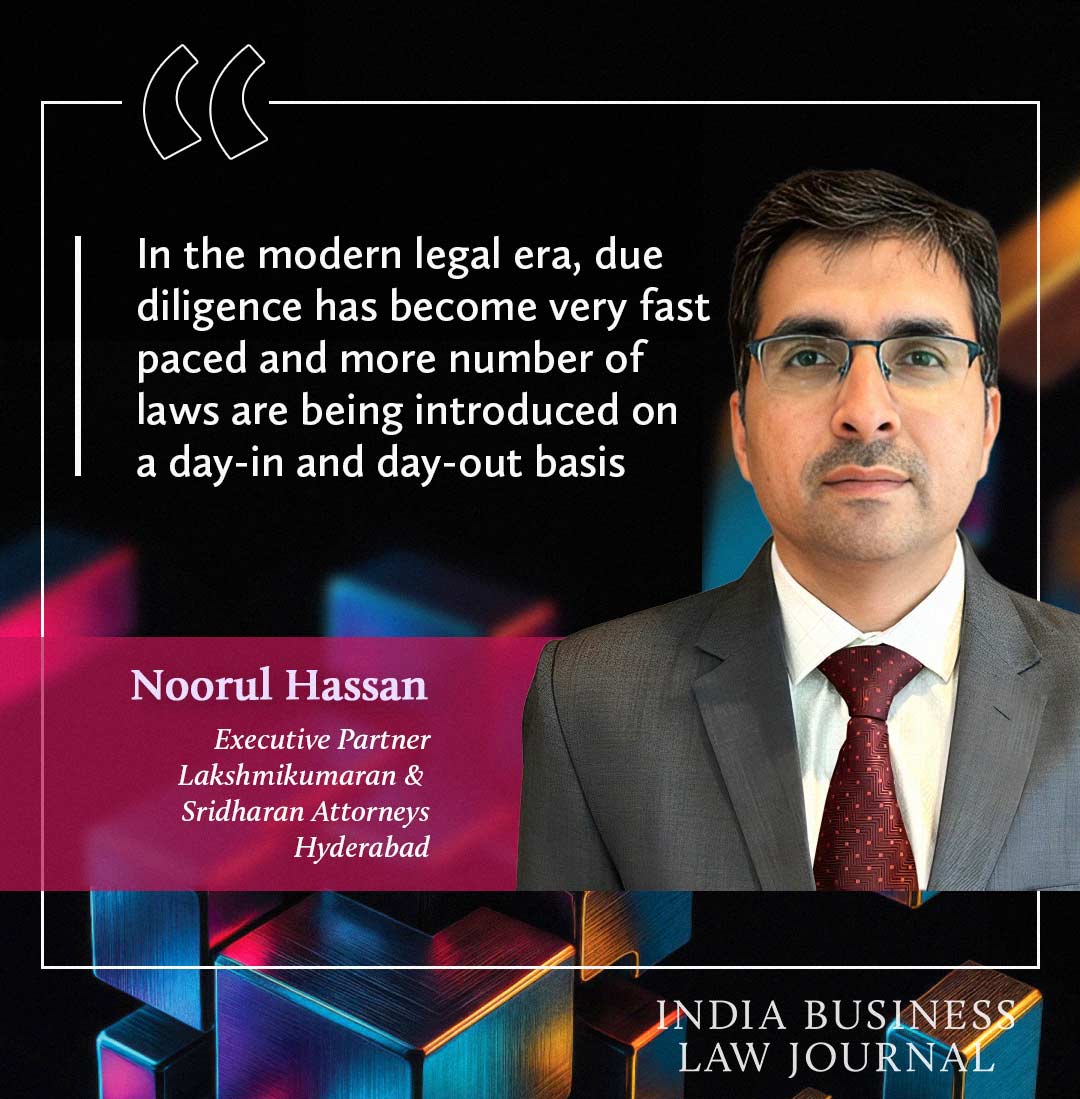
Hassan also points to a massive number of applicable laws. “In the modern legal era, due diligence has become very fast paced and more laws are being introduced on a day-in and day-out basis. Keeping pace with the ever-changing modern legal work has become very challenging and is only giving rise to specialisation.”
Anand says another major challenge lies in informal transactions. “Many family-run or legacy businesses may not have written contracts, proper employment agreements, compliance reports, tax filings or clear partnership arrangements,” he says. “Even sophisticated entities sometimes operate on trust-based relationships.”
From a due diligence perspective, Kumar says informal transactions mean “missing corporate documents, making complete verification difficult and reliant on representations”.
As Saraf explains, the result is lawyers having to “piece together information from multiple sources”. She also highlights a less acknowledged hurdle – the absence of willingness to share information by the other party, especially early in the process, which becomes an added challenge with deals that have close and tight deadlines.
The adoption of technology has also brought its own peculiar problems, including the challenges of virtual data rooms. “Collection of data and timely population of virtual data rooms is one of the foremost challenges that one faces while conducting due diligence,” says Hassan. “Often, the timelines are stretched since the entire data wouldn’t come in one go. At times, the data gets prepared when the checklist goes to the target.”
Another challenge is the regulatory mismatches for cross-border work. Inter-jurisdictional work transcends international borders but requires niche-trained and experienced lawyers, who often deal with regulatory mismatches between countries involved, where one type of regulation may not exist in another country.
“Investors, especially international [investors], are dealing with organisations and people that may not squarely fit in their existing ways of working … an aspect which may be considered fine in an Indian context of working may be considered as a red flag in an investor’s jurisdiction,” says Gupta. These aspects present a challenge, especially for international investors, to absorb the inherent risk limitations of organisations impacting the overall transaction contours, he adds.
Preparing for the future
Hassan predicts the future of due diligence will be tech-driven, predictive, and even more strategic. “AI will handle the heavy lifting in terms of document review, anomaly detection, cross-referencing, allowing lawyers to devote their time to judgment calls and negotiation strategy,” he says.
Kumar sees an evolution of the role of lawyers to reflect a strategic advisory nature, “ensuring that technology augments their role rather than replaces it, where they continue to safeguard commercial and regulatory risks”.
Saraf says the role of lawyer “will evolve” from data reviewer to risk strategist. “Many lawyers now build deep expertise in niche due diligence areas such as data protection, ESG, or sector-specific regulations.” Anand says due diligence will increasingly require lawyers who understand not just the law, but the commercial, technological, and geopolitical context of a deal.
“Cross-border diligence will require lawyers who understand multiple legal regimes and can harmonise conflicting norms. This is especially relevant in areas like data protection, digital competition, global tax rules, and AI governance.”
Anand emphasises evergreen skills for lawyers: “Soft skills, sectoral expertise and commercial judgment will become just as important as legal technicalities.”
Pirani says the scope for specialising in due diligence is definitely possible by developing niche expertise, for example regulatory or IP diligence for life sciences and healthcare, financial compliance and auditing for banking and fintech, or environmental, social and governance (ESG) compliance for projects and infrastructure transactions. “Over time, these specialisations will become highly valued because they combine legal acumen with deep industry and sectoral insight.”
Here’s a non-exhaustive look at what different types of compliance tasks can include:
GENERAL CORPORATE
- • Contracts (supply, distribution, joint venture, franchise)
- • Employment contracts, employee stock ownership plans (ESOPs)
- • Assets & liabilities
- • Real estate holdings
- • Loans, pledges, encumbrances
- • Corporate records, governance, shareholding, registrar of company (ROC) filings, structure
- • Charter documents
TAX
- • Direct and indirect tax compliance
- • GST filings
- • Transfer pricing
- • Tax litigation – disputes and assessments
- • Withholding tax history
- • Exposure to penalties
REGULATORY COMPLIANCE
- • Foreign direct investment (FDI), exchange control compliance
- • Sectoral laws
- • Data protection
- • Advertising codes
- • Environmental clearances
- • Factory, labour, PF & ESI compliances
- • Permits and licences attained or in process
- • Ongoing and possible future regulatory action
LITIGATION
- • Civil, criminal, regulatory and consumer cases, concluded, ongoing and threatened
- • Arbitration proceedings
- • Legacy disputes from earlier business cycles
- • Interim orders that may affect deal closure
FINANCIAL
- • Revenue, margins, working capital
- • Debt levels, outstanding loans
- • Accounting policies and irregularities
- • Cashflow sustainability
- • Internal books and declared books accuracy and match
LABOUR
- • Employment contracts and benefits
- • ESOPs
- • Work culture and environment
INTELLECTUAL PROPERTY (IP)
- • Ownership and chain-of-title of trademarks, copyrights, patents
- • Past assignments and licences
- • Conflicting marks or ongoing IP disputes
- • IP renewal status
- • Online infringements
- • Brand valuation drivers
- • Validity and scope of attained and in-process IP rights
- • Complete portfolio
REAL ESTATE
- • Title assessment
- • Encumbrances
- • Land-use compliances
- • Past, ongoing and possible disputes
ENVIRONMENTAL
- • Clearances, permissions, licences, etc.
- • Validity, renewal and scope
- • Garbage disposal practices and requirements
- • Hazardous material handling
- • Byproducts
Credits: Prepared with input from Safir R Anand, a senior partner and head of trademarks, contractual & commercial IP at Anand and Anand; Karun Prakash, partner at Shardul Amarchand Mangaldas & Co; Saurav Kumar, partner at CMS IndusLaw; and Taskeen Pirani, associate partner at Dentons Link Legal.