














In the runup to INTA’s 2025 annual meeting in San Diego, the association’s new president, Elisabeth Stewart Bradley, shares her belief that IP issues can be viewed through different lenses, writes Brian Yap
“Before coming to the biopharma landscape, I was with consumer products, and it is a very interesting lens to have both of those industries.”
It’s interesting that Elisabeth Stewart Bradley, the incoming 2025 president of the International Trademark Association (INTA), uses optics to describe her experience.
In an interview with Asia Business Law Journal ahead of the association’s annual meeting in San Diego from 17 to 21 May, and sitting against a backdrop of two maps showing very different regions of the world, New Jersey-based Bradley makes a point of emphasising the value of different industries having very different perspectives.
The new INTA head goes on to express her belief that some issues can be seen from several different vantage points.
“I have been encouraging INTA staff and committee members that as resolutions progress, to ensure we are really looking at these matters from a broad perspective so that the resolutions are fully informed and made stronger as a result of incorporating different perspectives from across our member base,” she says.
Through the interesting lens that she possesses, she has set out to serve the interests of the many different members of INTA as much as possible during her one-year tenure.
Outside of her INTA role, Bradley is currently serving as the vice president of innovation law at the US-based global biopharmaceutical company, Bristol Myers Squibb, leading its trademark, copyright and brand protection initiatives from the company’s New Jersey offices.
The viewpoints that she possesses have been formed through decades of experience across “different industries with very different perspectives”.
In the late 1990s, Bradley, then a Doctor of Law graduate from the University of Virginia School of Law with a BA in English literature from the College of William and Mary, began her legal career in private practice as an associate at Hunton & Williams, and later Morgan Lewis & Bockius in New York City, handling both litigation and IP matters.
After five years in private practice, she transitioned to the in-house legal world by joining UK-based confectionary giant Cadbury, where she worked as vice president and chief trademark counsel for the Americas during an eight-year stint. In 2011, Bradley joined Bristol Myers Squibb as assistant general counsel of trademark and copyright law before becoming vice president and head of trademark, copyright and brand protection in 2015.
Now at the helm of INTA, an organisation that she has served for multiple years in different roles, including vice president and board director, she speaks with openness and clarity about things she seeks to achieve and focus on in her leadership role.

“I do think about the big responsibility it is to have the honour to serve as the INTA president, and over the past several months, I have really found that I have sort of a North Star, which, for me, revolves around service and value,” she says.
A key part of Bradley’s North Star is her 2025 presidential taskforce, which will explore the evolution of in-house teams, the impact that change and transformation have on in-house teams’ external partners, and opportunities for the INTA to support its members through this change and transformation.
Bradley explains that, with the legal and business landscape rapidly evolving, the taskforce is observing the impact of complex dynamics such as geopolitics and rapidly evolving technologies on INTA members, so that it can anticipate how these dynamics will continue and accelerate in 2025 and beyond.
“We want to ensure that our members are not just surviving but thriving,” she says. “The taskforce is currently in the fact-finding and research stage, and is focused on engaging with a diverse range of members to discuss the changes in their practices that have occurred over the past few years.”
Bradley’s goal is to distill these learnings into forward-thinking and actionable initiatives that the organisation can implement to assist its members in navigating an ever-evolving and uncertain landscape.
The taskforce will report its findings via a presentation to the board of directors in November this year, during INTA’s leadership meeting. Bradley says that the final report may also be ready at that time but, as with some other years, the final written report from the presidential taskforce may possibly be released at a later date.
In Asia, the main task ahead for Bradley and her INTA team is to further engage the IP authorities of China and India, which have been drivers of the rapidly evolving legal and business landscape, as well as top sources of registrants for INTA’s annual meetings.
To Bradley, China and India are not only the key regional areas of focus for Asia, but they are markets that her company is particularly interested in.
“I know the whole biopharma industry is as well, in addition to many other industries,” she says.
For this year’s INTA annual meeting, registrants from China account for over 32% of more than 1,800 attendees from the Asia-Pacific, outstripping other Asian countries including India and Japan.
Bradley says there are several significant IP-related issues in China covering various areas from co-existence agreements and unregistrable marks to counterfeiting.
Representing INTA members, which include major corporate brand owners, law firms, service providers and small and medium-sized enterprises, Bradley has called on the Chinese IP authorities to address several issues, including providing further regulatory clarification.
One such issue is the lack of weight being given by Chinese trademark authorities to co-existence agreements negotiated between parties of potentially conflicting trademark rights. The INTA president points out that such agreements can be used as a tool to overcome confusion arising from objections based on an earlier, similar trademark issued by the trademark office and to facilitate registration.
But she observes that, since the second half of 2021, Chinese trademark authorities have not given as much weight to such agreements as they used to.
“Since the second half of 2021, the Chinese trademark authorities have prioritised public interest over party autonomy, which have led to the changes … We do suggest continuing the previous policy of providing weight to these co-existence agreements.”
Bradley also points to the issue of counterfeiting in China, describing it as a significant challenge faced by many countries around the world. She stresses that some key areas can benefit from further regulatory clarification in China, including a statutory response framework.
“We understand that the current law does not actually specify a timeframe within which an e-commerce platform must act upon receiving an infringement notification from a brand owner.”
Similar to China, the new INTA head also considers enforcement of IP rights to be a concern in India, including counterfeiting challenges that mirror those in jurisdictions around the world.
India is one of the top sources of registrations for this year’s INTA annual meeting, accounting for about 20% of the total registrations from the Asia-Pacific.
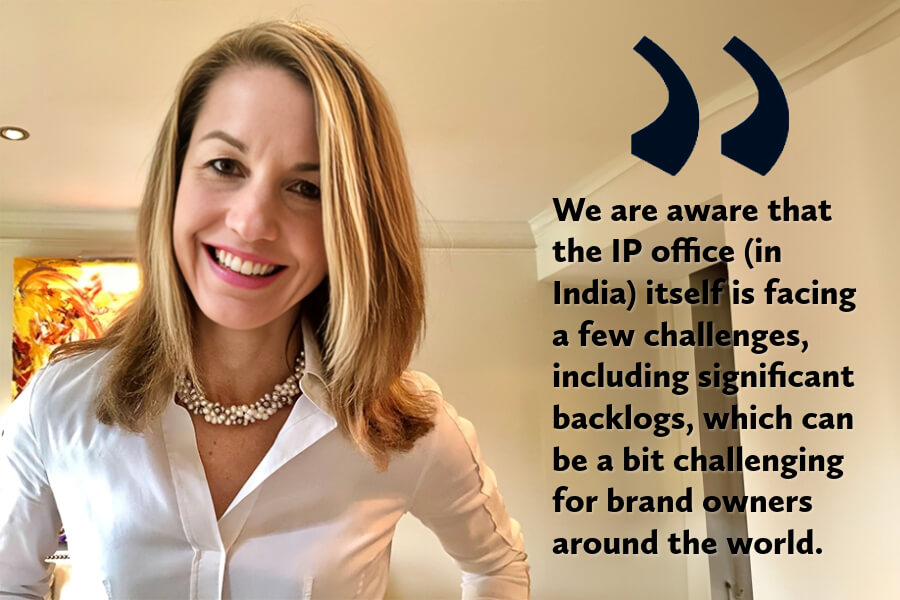
“We are aware that the IP office (in India) itself is facing a few challenges, including significant backlogs, which can be a bit challenging for brand owners around the world.”
Calling India a significant jurisdiction in the global fight against counterfeiting, Bradley says that the INTA is working closely with Indian authorities to support efforts in strengthening and modernising India’s IP enforcement, as well as increased co-ordination with rights holders.
“In 2024 alone, INTA partnered with Indian customs, the US Department of Justice and other stakeholders to deliver high-level training sessions across major cities. We also submitted detailed recommendations to enhance customs enforcement procedures and continue to advocate for the creation of a National IP Co-ordination Centre in India.”
This year, under her leadership, the INTA will continue its efforts and sustained engagement with Indian IP authorities through a dedicated South Asia anti-counterfeiting subcommittee. Bradley says that all of this hard work is aimed at supporting India’s endeavour to create a stronger, more co-ordinated anti-counterfeiting framework.
But India and China are not the only major Asian IP jurisdictions on Bradley’s mind, as developments across Asia are of interest to many INTA members.
“In addition to the annual meeting and the other events, I will have the opportunity to travel to several different Asian countries in 2025, and I will learn so much from those travels and members,” she says.
Japan, which is one of the top sources of registrations for this year’s INTA annual meeting, accounting for about 15% of the total for the Asia-Pacific, is a jurisdiction that impresses Bradley in terms of both IP prosecution and enforcement.
You must be a
subscribersubscribersubscribersubscriber
to read this content, please
subscribesubscribesubscribesubscribe
today.
For group subscribers, please click here to access.
Interested in group subscription? Please contact us.
你需要登录去解锁本文内容。欢迎注册账号。如果想阅读月刊所有文章,欢迎成为我们的订阅会员成为我们的订阅会员。